You can get this Member Handbook and other plan materials in other languages for free. Community Health Group provides written translations from qualified translators. Call 1-800-224-7766 (TTY 1-855-266-4584 or 711). The call is free. Read this Member Handbook to learn more about health care language assistance services such as interpreter and translation services.

Member Handbook
What you need to know about your benefits
Community Health Group Combined Evidence of Coverage(EOC) and Disclosure Form
2026
San Diego
Other languages
Other formats
You can get this information in other formats such as braille, 20-point font large print, audio format, and accessible electronic formats (data CD) at no cost to you. Call 1-800-224-7766 (TTY 1-855-266-4584 or 711). The call is free.
Interpreter services
Community Health Group provides oral interpretation services, as well as sign language, from a qualified interpreter, on a 24-hour basis, at no cost to you. You do not have to use a family member or friend as an interpreter. We discourage the use of minors as interpreters unless it is an emergency. Interpreter, linguistic, and cultural services are available for free. Help is available 24 hours a day, 7 days a week. For help in your language, or to get this handbook in a different language, call 1-800-224-7766 (TTY 1-855-266-4584 or 711). The call is free.
ATTENTION: If you need help in your language, call 1-800-224-7766 (TTY: 1-855-266-4584). Aids and services for people with disabilities, like documents in braille and large print, are also available. Call 1-800-224-7766 (TTY: 1-855-266-4584). These services are free of charge.
اﻟﻌرﺑﯾﺔ (Arabic)
اﻧﺗﺑﺎه: إذا ﻛﻧت ﺑﺣﺎﺟﺔ إﻟﻰ ﻣﺳﺎﻋدة ﺑﻠﻐﺗك، ﻓﺎﺗﺻل ﻋﻠﻰ
1-800-224-7766 (TTY: 1-855-266-4584). ﻛﻣﺎ ﺗﺗوﻓر ﻣﺳﺎﻋدات وﺧدﻣﺎت ﻟﻸﺷﺧﺎص ذوي
اﻹﻋﺎﻗﺔ، ﻣﺛل ﻣﺳﺗﻧدات ﺑطرﯾﻘﺔ ﺑراﯾل وﺑﺎﻟﺧط اﻟﻛﺑﯾر. ھذه اﻟﺧدﻣﺎت ﻣﺟﺎﻧﯾﺔ.
繁體中文 (Traditional Chinese)
請注意:如果您需要以您的語言提供幫助,請致電 1-800-224-7766
(TTY:
1-855-266-4584)。我們也提供給殘障人士的協助和服務,例如點字和大字體文件。請致電 1-800-224-7766 (TTY: 1-855-266-4584)。這些服務免費提供。
Español (Spanish)
ATENCIÓN: Si necesita ayuda en su
idioma, llame al 1-800-224-7766
(TTY: 1-855-266-4584).
También hay ayudas y servicios para
personas con discapacidades, como documentos en braille y en letra grande. Llame al 1-800-224-7766 (TTY: 1-855-266-4584). Estos
servicios son gratuitos.
ﻓﺎرﺳﯽ (Farsi)
ﺗوﺟﮫ: اﮔر ﺑﮫ ﮐﻣﮏ ﺑﮫ زﺑﺎن ﺧود ﻧﯾﺎز دارﯾد، ﺑﺎ
1-800-224-7766 (TTY: 1-855-266-4584) ﺗﻣﺎس ﺑﮕﯾرﯾد. ﮐﻣﮏھﺎ و ﺧدﻣﺎﺗﯽ ﺑرای اﻓراد
دارای ﻣﻌﻠوﻟﯾت، ﻣﺎﻧﻧد اﺳﻧﺎد ﺑرﯾل و ﭼﺎپ درﺷت ﻧﯾز در دﺳﺗرس اﺳت. اﯾن ﺧدﻣﺎت راﯾﮕﺎن ھﺳﺗﻧد.
한국어 (Korean)
주의: 귀하의 언어로 도움이 필요하신 경우 1-800-224-7766 (TTY: 1-855-266-4584)번으로 전화하십시오. 점자 및 큰 활자 문서와 같은 장애인을 위한 지원
및 서비스도 제공됩니다. 1-800-224-7766 (TTY: 1-855-266-4584)번으로 전화하십시오. 이 서비스는 무료입니다.
Русский (Russian)
ВНИМАНИЕ! Если вам нужна помощь на вашем языке,
звоните по номеру 1-800-224-7766 (TTY: 1-855-266-4584). Также предоставляются вспомогательные
средства и услуги для людей с ограниченными возможностями, например, документы шрифтом
Брайля и крупным шрифтом. Звоните по номеру 1-800-224-7766 (TTY: 1-855-266-4584). Эти услуги предоставляются бесплатно.
Tiếng Việt (Vietnamese)
CHÚ Ý: Nếu quý vị cần
trợ giúp bằng ngôn ngữ của mình, vui lòng gọi số 1-800-224-7766 (TTY: 1-855-266-4584). Chúng
tôi cũng hỗ trợ và cung cấp các
dịch vụ cho người khuyết tật, như tài liệu chữ nổi Braille và bản in chữ
lớn. Vui lòng
gọi số 1-800-224-7766 (TTY: 1-855-266-4584). Các
dịch vụ này đều miễn phí.
Tagalog (Filipino)
PAUNAWA: Kung kailangan mo ng tulong sa iyong
wika, tumawag sa 1-800-224-7766
(TTY: 1-855-266-4584). Mayroon
ding mga tulong at serbisyo
para sa mga taong may kapansanan, tulad ng mga dokumentong nakasulat sa braille at
malalaking titik. Tumawag sa 1-800-224-7766 (TTY: 1-855-266-4584). Libre ang mga serbisyong ito.
Հայերեն (Armenian)
ՈՒՇԱԴՐՈՒԹՅՈՒՆ: Եթե Ձեզ օգնություն է հարկավոր Ձեր
լեզվով, զանգահարեք 1-800-224-7766 (TTY: 1-855-266-4584). Կան նաև օժանդակ միջոցներ ու
ծառայություններ հաշմանդամություն ունեցող անձանց համար, օրինակ՝ Բրայլի գրատիպով ու
խոշորատառ տպագրված նյութեր։ Զանգահարեք 1-800-224-7766
(TTY: 1-855-266-4584). Այդ
ծառայություններն անվճար են։
ែខ្មរ (Cambodian)
ចំណំ៖
េបើអ្នក្រតវការជំនួយជភាȨសារបស់អ្នក សូមទូរស័ព្ទេ 1-800-224-7766 (TTY: 1-855-266-4584)។ មាȨនជំនួយ
និងេសវស្រមាȨប់ជនពិការផងែដរ
ដូចជឯកសារជអក្សរ្របាយ និងអក្សរធំៗ។ សូមទូរស័ព្ទេ 1-800-224-7766 (TTY: 1-855-266-4584)។
េសវទាᶰំងេនះមាȨនឱ្យេដយឥតគិតៃថ្ល។
िहन्दी (Hindi)
ध्यान दें: अगर आपको अपनी भाषा में सहायता की आवश्यकता
है तो 1-800-224-7766 (TTY: 1-855-266-4584) पर कॉल करें।
अशक्तता वाले लोगों के लिए
ब्रेल और बड़े अक्षरों में दस्तावेज़ जैसी सेवाएं भी उपलब्ध हैं। कृपया 1-800-224-7766 (TTY: 1-855-266-4584) पर कॉल करें।
ये सेवाएं नि:शुल्क हैं।
Hmoob (Hmong)
CEEB TOOM: Yog koj xav tau kev pab txhais koj hom
lus, hu rau 1-800-224-7766
(TTY: 1-855-266-4584). Muaj cov
kev pab thiab kev pab cuam
rau cov neeg xiam oob khab, xws li ntawv luam ua ntawv loj thiab ntawv Braille. Hu rau
1-800-224-7766 (TTY: 1-855-266-4584). Cov kev pab
cuam no yog dawb.
日本語 (Japanese)
注意: 日本語での支援が必要な場合は、1-800-224-7766 (TTY: 1-855-266-4584)
にお電話ください。点字や大きな文字で書かれた書類など、障害をお持ちの方のための支援やサービスも提供しています。1-800-224-7766 (TTY: 1-855-266-4584)
にお電話ください。これらのサービスは無料です。
ພາສາລາວ (Laotian)
ປະກາດ: ຖ້າທ່ານຕ້ອງການຄວາມຊ່ວຍເຫືຼອໃນພາສາຂອງທ່ານ,
ໃຫໂ້ທຫາ 1-800-224-7766 (TTY: 1-855-266-4584).
ຍັງມີການຊ່ວຍເຫືຼອແລະການບໍລິການສໍາລັບຜູ້ພິການ, ເຊັ່ນເອກະສານທີ່ພິມໂດຍອັກສອນບາຣ໌ລ
ແລະພິມໂຕໃຫຍ່. ໂທ 1-800-224-7766
(TTY: 1-855-266-4584).
ການບໍລິການເຫົ່ຼານີ້ໃຫຟ້ຣີ.
Mien
LONGC HNYOUV JANGX LONGX OC: Beiv taux meih qiemx longc mienh
tengx faan benx meih nyei
waac nor douc waac daaih lorx taux 1-800-224-7766 (TTY:
1-855-266-4584). Liouh lorx
jauv-louc tengx aengx caux
nzie gong bun taux ninh mbuo wuaaic fangx mienh, beiv taux longc benx nzangc-pokc bun
hluo mbiutc aengx caux aamz mborqv benx domh sou se mbenc nzoih bun longc. Douc waac
daaih lorx 1-800-224-7766 (TTY:
1-855-266-4584). Naaiv deix
nzie weih gong-bou
jauv-louc se benx wang-henh tengx mv zuqc cuotv nyaanh oc.
ਪੰਜਾਬੀ (Punjabi)
ਿਧਆਨ ਿਧਓ: ਜੇ ਤੁਹਾਨੰੂ ਆਪਣੀ ਭਾਸ਼ਾ ਿਵੱਚ ਮਦਦ ਦੀ ਲੋੜ
ਹੈ, ਤਾਂ 1-800-224-7766 (TTY: 1-855-266-4584) 'ਤੇ ਕਾਲ ਕਰੋ।
ਅਸੀਂ ਉਪਲਬਧ ਕਰਵਾਉਂਦੇ ਹਾਂ
ਸਹਾਇਤਾ ਅਤੇ ਸੇਵਾਵਾਂ ਜੋ ਿਕ ਅਪਾਹਜ ਿਵਅਕਤੀਆਂ ਲਈ ਹਨ, ਿਜਵੇਂ ਿਕ ਬ੍ਰੇਲ ਅਤੇ ਵੱਡੇ ਅੱਖਰਾਂ ਵਾਲੇ
ਦਸਤਾਵੇਜ਼। ਿਕਰਪਾ ਕਰਕੇ 1-800-224-7766 (TTY: 1-855-266-4584) 'ਤੇ ਕਾਲ ਕਰੋ। ਇਹ ਸੇਵਾਵਾਂ ਮੁਫ਼ਤ ਹਨ।
ภาษาไทย (Thai)
โปรดทราบ: หากคุณต้องการความช่วยเหลือเป็นภาษาของคุณ
กรุณาโทร 1-800-224-7766 (TTY:
1-855-266-4584).
มีบริการช่วยเหลือและบริการสําหรับผู้พิการ เช่น เอกสารอักษรเบรลล์และตัวพิมพ์ขนาดใหญ่
กรุณาโทร 1-800-224-7766 (TTY: 1-855-266-4584).
บริการเหล่านี้ฟรี.
Українська (Ukrainian)
УВАГА! Якщо вам потрібна допомога вашою
мовою, зателефонуйте за номером 1-800-224-7766 (TTY: 1-855-266-4584). Також надаються допоміжні засоби та
послуги для людей з інвалідністю, наприклад документи шрифтом Брайля або великим
шрифтом. Зателефонуйте за номером 1-800-224-7766 (TTY:
1-855-266-4584). Ці послуги є
безкоштовними.
Welcome to Community Health Group!
Thank you for joining Community Health Group. Community Health Group is a health plan for people who have Medi-Cal. Community Health Group works with the State of California to help you get the health care you need.
Member Handbook
This Member Handbook tells you about your coverage under Community Health Group. Please read it carefully and completely. It will help you understand your benefits, the services available to you, and how to get the care you need. It also explains your rights and responsibilities as a member of Community Health Group. If you have special health needs, be sure to read all sections that apply to you.
This Member Handbook is also called the Combined Evidence of Coverage (EOC) and Disclosure Form. This EOC and Disclosure Form constitutes only a summary of the health plan. The health plan contract must be consulted to determine the exact terms and conditions of coverage. To learn more, call Community Health Group at 1-800-224-7766 (TTY 1-855-266-4584 or 711).
In this Member Handbook, Community Health Group is sometimes referred to as “we” or “us.” Members are sometimes called “you.” Some capitalized words have special meaning in this Member Handbook.
To ask for a copy of the contract between Community Health Group and the California Department of Health Care Services (DHCS), call 1-800-224-7766 (TTY 1-855-266-4584 or 711). You may ask for another copy of the Member Handbook for free. You can also find the Member Handbook on the Community Health Group website at www.chgsd.com. You can also ask for a free copy of Community Health Group non-proprietary clinical and administrative policies and procedures. They are also on the Community Health Group website www.chgsd.com.
Contact us
Community Health Group is here to help. If you have questions, call 1-800-224-7766 (TTY 1-855-266-4584 or 711). Community Health Group is here 24 hours a day, 7 days a week. The call is free.
You can also visit online at any time at www.chgsd.com.
Thank you,
Community Health Group2420 Fenton Street, Suite 100
Chula Vista, CA 91914
1.1 How to get help
Community Health Group wants you to be happy with your health care. If you have questions or concerns about your care, Community Health Group wants to hear from you!
Member Services
Community Health Group Member Services is here to help you. Community Health Group can:
- Answer questions about your health plan and Community Health Group covered services.
- Help you choose or change a primary care provider (PCP).
- Tell you where to get the care you need.
- Help you get interpreter services if you speak limited English.
- Help you get information in other languages and formats.
- Help you with problems with service or care
- Help you with requests for copies of Health Plan materials
- Help you if you receive bills from a provider
- Help you understand how your health plan is organized and operates
If you need help, call 1-800-224-7766 (TTY 1-855-266-4584 or 711). Community Health Group is here 24 hours a day, 7 days a week. The call is free. Community Health Group must make sure you wait less than 10 minutes when calling.
You can also visit Member Services online at any time at www.chgsd.com. You can also access Community Health Group’s member portal (https://memberportal.chgsd.com/Login) to update your personal information, request an identification card, and change your primary care provider, among other things.
1.2 Who can become a member
Every state may have a Medicaid program. In California, Medicaid is called Medi-Cal.
You qualify for Community Health Group because you qualify for Medi-Cal and live in San Diego County. You might also qualify for Medi-Cal through Social Security because you are getting SSI or SSP.
For questions about enrollment, call Health Care Options at 1-800-430-4263 (TTY 1-800-430-7077 or 711), or go to http://www.healthcareoptions.dhcs.ca.gov/.
For questions about Social Security, call the Social Security Administration at 1-800-772-1213, or go to https://www.ssa.gov/locator/.
Transitional Medi-Cal
You may be able to get Transitional Medi-Cal if you started earning more money and you no longer qualify for Medi-Cal.
You can ask questions about qualifying for Transitional Medi-Cal at your local county office at:
http://www.dhcs.ca.gov/services/medi-cal/Pages/CountyOffices.aspxOr call Health Care Options at 1-800-430-4263 (TTY 1-800-430-7077 or 711).
1.3 Identification (ID) cards
As a member of Community Health Group, you will get our Community Health Group Identification (ID) card. You must show your Community Health Group ID card and your Medi-Cal Benefits Identification Card (BIC) when you get health care services or prescriptions. Your Medi-Cal BIC card is the benefits identification card sent to you by the State of California. You should always carry all health cards with you. Your Medi-Cal BIC and Community Health Group ID cards look like these:

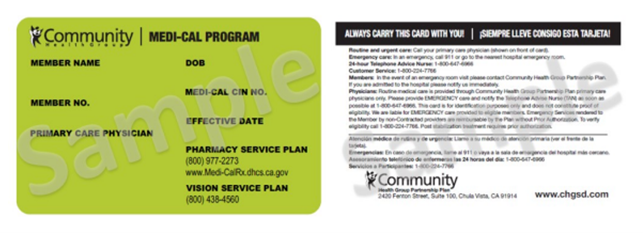
If you do not get your Community Health Group ID card within a few weeks after your enrollment date, or if your Community Health Group ID card is damaged, lost, or stolen, call Member Services right away. Community Health Group will send you a new card for free. Call 1-800-224-7766 (TTY 1-855-266-4584 or 711). If you do not have a Medi-Cal BIC card or if your card is damaged, lost, or stolen, call the local county office. To find your local county office, go to http://www.dhcs.ca.gov/services/medi-cal/Pages/CountyOffices.aspx.
2.1 Health plan overview
Community Health Group is a health plan for people who have Medi-Cal in San Diego County. Community Health Group works with the State of California to help you get the health care you need.
Talk with one of the Community Health Group Member Services representatives to learn more about the health plan and how to make it work for you. Call 1-800-224-7766 (TTY 1-855-266-4584 or 711). We are available to assist you 24 hours a day, 7 days a week.
When your coverage starts and ends
When you enroll in Community Health Group, we will send your Community Health Group Identification (ID) card within two weeks of your enrollment date. You must show both your Community Health Group ID card and your Medi-Cal Benefits Identification Card (BIC) when you get health care services or prescriptions.
Your Medi-Cal coverage will need renewing every year. If your local county office cannot renew your Medi-Cal coverage electronically, the county will send you a pre-populated Medi-Cal renewal form. Complete this form and return it to your local county office. You can return your information in person, by phone, by mail, online, or by other electronic means available in your county.
You can end your Community Health Group coverage and choose another health plan at any time. For help choosing a new plan, call Health Care Options at 1-800-430-4263 (TTY 1-800-430-7077 or 711), or go to www.healthcareoptions.dhcs.ca.gov.
Community Health Group is a health plan for Medi-Cal members in San Diego County. Find your local county office at http://www.dhcs.ca.gov/services/medi-cal/Pages/CountyOffices.aspx.
Community Health Group Medi-Cal coverage may end if any of the following is true:
- You move out of San Diego county.
- You no longer have Medi-Cal.
- You become eligible for a waiver program that requires you to be enrolled in Fee-for-Service (FFS) Medi-Cal.
- You are in jail or prison.
If you lose your Community Health Group Medi-Cal coverage, you may still qualify for FFS Medi-Cal coverage. If you are not sure if you are still covered by Community Health Group, call 1-800-224-7766 (TTY 1-855-266-4584 or 711).
Special considerations for American Indians in managed care
American Indians have a right to not enroll in a Medi-Cal managed care plan or they may leave their Medi-Cal managed care plan and return to FFS Medi-Cal at any time and for any reason.
If you are an American Indian, you have the right to get health care services at an Indian Health Care Provider (IHCP). You can also stay with or disenroll (drop) from Community Health Group while getting health care services from these locations. To learn more about enrollment and disenrollment, call 1-800-224-7766 (TTY 1-855-266-4584 or 711).
Community Health Group must provide care coordination for you, including in- and out-of-network case management. If you ask to get services from an IHCP, Community Health Group must help you find an in- or out-of-network IHCP of your choice. To learn more, read “Provider network” in Chapter 3 of this handbook.
2.2 How your plan works
Community Health Group is a managed care health plan contracted with DHCS. Community Health Group works with doctors, hospitals, and other providers in the Community Health Group service area to provide health care to our members. As a member of Community Health Group, you may qualify for some services provided through FFS Medi-Cal. These include outpatient prescriptions, non-prescription drugs, and some medical supplies through Medi-Cal Rx.
Member Services will tell you how Community Health Group works, how to get the care you need, how to schedule provider appointments during office hours, how to request free interpreting and translation services or written information in alternative formats, and how to find out if you qualify for transportation services.
To learn more, call 1-800-224-7766 (TTY 1-855-266-4584 or 711). You can also find Member Services information online at www.chgsd.com.
2.3 Changing health plans
You can leave Community Health Group and join another health plan in your county of residence at any time if another health plan is available. To choose a new plan, call Health Care Options at 1-800-430-4263 (TTY 1-800-430-7077 or 711). You can call between 8 a.m. and 6 p.m. Monday through Friday, or go to https://www.healthcareoptions.dhcs.ca.gov.
It takes up to 30 days or more to process your request to leave Community Health Group and enroll in another plan in your county. To find out the status of your request, call Health Care Options at 1-800-430-4263 (TTY 1-800-430-7077 or 711).
If you want to leave Community Health Group sooner, you can call Health Care Options to ask for an expedited (fast) disenrollment.
Members who can request expedited disenrollment include, but are not limited to, children getting services under the Foster Care or Adoption Assistance programs, members with special health care needs, and members already enrolled in Medicare or another Medi-Cal or commercial managed care plan.
You can ask to leave Community Health Group by contacting your local county office. Find your local county office at: http://www.dhcs.ca.gov/services/medi-cal/Pages/CountyOffices.aspxor call Health Care Options at 1-800-430-4263 (TTY 1-800-430-7077 or 711).
2.4 Students who move to a new county or out of California
You can get emergency care and urgent care anywhere in the United States, including the United States Territories. Routine and preventive care are covered only in your county of residence. If you are a student who moves to a new county in California to attend higher education, including college, Community Health Group will cover emergency room and urgent care services in your new county. You can also get routine or preventive care in your new county, but you must notify Community Health Group.
Read more below.
If you are enrolled in Medi-Cal and are a student in a different county from the California county where you live, you do not need to apply for Medi-Cal in that county.
If you temporarily move away from home to be a student in another county in California, you have two choices. You can:
- Tell your eligibility worker at the San Diego County Resource Center that you are temporarily moving to attend a school for higher education and give them your address in the new county. The county will update the case records with your new address and county code. You must do this if you want to keep getting routine or preventive care while you live in a new county. If Community Health Group does not serve the county where you will attend college, you might have to change health plans. For questions and to prevent delay in joining a new health plan, call Health Care Options at 1-800-430-4263 (TTY 1-800-430-7077 or 711).
Or
- If Community Health Group does not serve the new county where you attend college, and you do not change your health plan to one that serves that county, you will only get emergency room and urgent care services for some conditions in the new county. To learn more, read Chapter 3, “How to get care” in this handbook. For routine or preventive health care, you would need to use a Community Health Group network of providers located in San Diego County.
If you are leaving California temporarily to be a student in another state and you want to keep your Medi-Cal coverage, contact your eligibility worker at a San Diego County Resource Center. As long as you qualify, Medi-Cal will cover emergency care and urgent care in another state. Medi-Cal will also cover emergency care that requires hospitalization in Canada and Mexico.
Routine and preventive care services are not covered when you are outside of California. You will not qualify for Medi-Cal medical benefit coverage for those out-of-state services. Community Health Group will not pay for your health care. If you want Medicaid in another state, you will need to apply in that state. Medi-Cal does not cover emergency, urgent, or any other health care services outside of the United States, except for emergency care requiring hospitalization in Canada and Mexico as noted in Chapter 3.
Out-of-state pharmacy benefits are limited to up to a 14-day emergency supply when delays would prevent a medically necessary service. For more help, call Medi-Cal Rx at 1-800-977-2273 or visit them online at https://medi-calrx.dhcs.ca.gov/home.
2.5 Continuity of care
Continuity of care for an out-of-network provider
As a member of Community Health Group, you will get your health care from providers in Community Health Group’s network. To find out if a health care provider is in the Community Health Group network, please see the provider directory published at www.chgsd.com. Providers not listed in the directory may not be in the Community Health Group network.
In some cases, you might be able to get care from providers who are not in the Community Health Group network. If you were required to change your health plan or to switch from FFS Medi-Cal to managed care, or you had a provider who was in network but is now outside the network, you might be able to keep your provider even if they are not in the Community Health Group network. This is called continuity of care.
If you need to get care from a provider who is outside the network, call Community Health Group to ask for continuity of care. You may be able to get continuity of care for up to 12 months or more if all of these are true:
- You have an ongoing relationship with the out-of-network provider before enrollment in Community Health Group.
- You went to the out-of-network provider for a non-emergency visit at least once during the 12 months before your enrollment with Community Health Group.
- The out-of-network provider is willing to work with Community Health Group and agrees to Community Health Group’s contract requirements and payment for services.
- The out-of-network provider meets Community Health Group’s professional standards.
- The out-of-network provider is enrolled and participating in the Medi-Cal program. To learn more, call Member Services at 1-800-224-7766 (TTY 1-855-266-4584 or 711).
If your providers do not join the Community Health Group network by the end of 12 months, do not agree to Community Health Group payment rates, or do not meet quality of care requirements, you will need to change to providers in the Community Health Group network. To discuss your choices, call Member Services at 1-800-224-7766 (TTY 1-855-266-4584 or 711).
Community Health Group is not required to provide continuity of care for an out-of-network provider for certain ancillary (supporting) services such as radiology, laboratory, dialysis centers, or transportation. You will get these services with a provider in Community Health Group’s network.
To learn more about continuity of care and if you qualify, call Member Services.
Completion of covered services from an out-of-network provider
As a member of Community Health Group, you will get covered services from providers in Community Health Group’s network. If you are being treated for certain health conditions at the time you enrolled with Community Health Group or at the time your provider left Community Health Group’s network, you might also still be able to get Medi-Cal services from an out-of-network provider.
You might be able to continue care with an out-of-network provider for a specific time period if you need covered services for these health conditions:
Health condition | Time period |
|---|---|
Acute conditions (a medical issue that needs fast attention). | For as long as your acute condition lasts. |
Serious chronic physical and behavioral conditions (a serious health care issue you have had for a long time). | For up to 12 months from the coverage start or the date the provider’s contract ends with Community Health Group. |
Pregnancy and postpartum (after birth) care. | During your pregnancy and up to 12 months after the end of pregnancy. |
Maternal mental health services. | For up to 12 months from the diagnosis or from the end of your pregnancy, whichever is later. |
Care of a newborn child between birth and 36 months old. | For up to 12 months from the start date of the coverage or the date the provider’s contract ends with Community Health Group. |
Terminal illness (a life-threatening medical issue). | For as long as your illness lasts. You may still get services for more than 12 months from the date you enrolled with Community Health Group or the time the provider stops working with Community Health Group. |
Performance of a surgery or other medical procedure from an out-of-network provider as long as it is covered, medically necessary, and authorized by Community Health Group as part of a documented course of treatment and recommended and documented by the provider. | The surgery or other medical procedure must take place within 180 days of the provider’s contract termination date or 180 days from the effective date of your enrollment with Community Health Group. |
For other conditions that might qualify, call Community Health Group’s Member Services.
If an out-of-network provider is not willing to keep providing services or does not agree to Community Health Group’s contract requirements, payment, or other terms for providing care, you will not be able to get continued care from the provider. You may be able to keep getting services from a different provider in Community Health Group’s network.
For help choosing a contracted provider to continue with your care or if you have questions or problems getting covered services from a provider who is no longer in Community Health Group’s network, call Member Services at 1-800-224-7766 (TTY 1-855-266-4584 or 711).
Community Health Group is not required to provide continuity of care for services Medi-Cal does not cover or that are not covered under Community Health Group’s contract with DHCS. To learn more about continuity of care, eligibility, and available services, call Member Services.
2.6 Costs
Member costs
Community Health Group serves people who qualify for Medi-Cal. In most cases, Community Health Group members do not have to pay for covered services, premiums, or deductibles.
If you are an American Indian, you do not have to pay enrollment fees, premiums, deductibles, co-pays, cost sharing, or other similar charges. Community Health Group must not charge any American Indian member who gets an item or service directly from an IHCP or through a referral to an IHCP or reduce payments due to an IHCP by the amount of any enrollment fee, premium, deductible, copayment, cost sharing, or similar charge.
If you are enrolled in the County Children’s Health Initiative Program (CCHIP) in Santa Clara, San Francisco, or San Mateo counties or are enrolled in Medi-Cal for Families, you might have a monthly premium and co-pays.
Except for emergency care, urgent care that is outside the Community Health Group service area, or sensitive care, you must get pre-approval (prior authorization) from Community Health Group before you visit a provider outside the Community Health Group network. If you do not get pre-approval (prior authorization) and you go to a provider outside the network for care that is not emergency care, out-of-area urgent care, or sensitive care, you might have to pay for care you got from that provider. For a list of covered services, read Chapter 4, “Benefits and services” in this handbook. You can also find the Provider Directory on the Community Health Group website at www.chgsd.com.
For members with long-term care and a Monthly Resident Cost
You might have to pay a Monthly Resident Cost (share of cost) each month for your long-term care services. The amount of your Monthly Resident Cost depends on your income. Each month, you will pay your own health care bills, including but not limited to, long-term care bills, until the amount you have paid equals your Monthly Resident Cost. After that, Community Health Group will cover your long-term care for that month. You will not be covered by Community Health Group until you have paid your entire long-term care Monthly Resident Cost for the month.
How a provider gets paid
Community Health Group pays providers in these ways:
- Capitation payments
- Community Health Group pays some providers a set amount of money every month for each Community Health Group member. This is called a capitation payment. Community Health Group and providers work together to decide on
the payment amount.
- FFS payments
- Some providers give care to Community Health Group members and send Community Health Group a bill for the services they provided. This is called an FFS payment. Community Health Group and providers work together to decide how much each service costs.
- Per Diem payments
- Per Diem means that Community Health Group pays a set dollar amount per day for a member’s care.
- Case rate payments
- A case rate is a set amount paid for a specific health procedure or episode of treatment. Case rates usually apply to situations that require hospitalization.
To learn more about how Community Health Group pays providers, call 1-800-224-7766 (TTY 1-855-266-4584 or 711).
Provider Incentive Programs
Community Health Group has special programs that reward healthcare providers. These rewards are given when the providers offer excellent care to our members, measured by certain quality standards. We check these rewards every year to make sure our members get the best care. You have the right to request additional information about these programs. To request additional information, please call Member Services at 1-800-224-7766 (TTY 1-855-266-4584 or 711).
If you get a bill from a health care provider
Covered services are health care services that Community Health Group must pay. If you get a bill for any Medi-Cal covered services, do not pay the bill. Call Member Services right away at 1-800-224-7766 (TTY 1-855-266-4584 or 711). Community Health Group will help you figure out if the bill is correct.
If you get a bill from a pharmacy for a prescription drug, supplies, or supplements, call Medi-Cal Rx Customer Service at 1-800-977-2273, 24 hours a day, 7 days a week. TTY users can use option 7 or call 711. You can also go to the Medi-Cal Rx website at https://medi-calrx.dhcs.ca.gov/home/.
Asking Community Health Group to pay you back for expenses
If you paid for services that you already got, you might qualify to be reimbursed (paid back) if you meet all of these conditions:
- The service you got is a covered service that Community Health Group is responsible for paying. Community Health Group will not reimburse you for a service that Community Health Group does not cover.
- You got the covered service while you were an eligible Community Health Group member.
- You ask to be paid back within one year from the date you got the covered service.
- You show proof that you, or someone on your behalf, paid for the covered service, such as a detailed receipt from the provider.
- You got the covered service from a Medi-Cal enrolled provider in Community Health Group’s network. You do not need to meet this condition if you got emergency care, family planning services, or another service that Medi-Cal allows out-of-network providers to perform without pre-approval (prior authorization).
- If the covered service normally requires pre-approval (prior authorization), you need to give proof from the provider that shows a medical need for the covered service.
Community Health Group will tell you if they will reimburse you in a letter called a Notice of Action (NOA). If you meet all of the above conditions, the Medi-Cal-enrolled provider should pay you back for the full amount you paid. If the provider refuses to pay you back, Community Health Group will pay you back for the full amount you paid.
If the provider is enrolled in Medi-Cal but is not in the Community Health Group network and refuses to pay you back, Community Health Group will pay you back, but only up to the amount that FFS Medi-Cal would pay. Community Health Group will pay you back for the full out-of-pocket amount for emergency care, family planning services, or another service that Medi-Cal allows to be provided by out-of-network providers without pre-approval (prior authorization). If you do not meet one of the above conditions, Community Health Group will not pay you back.
Community Health Group will not pay you back if:
- You asked for and got services that are not covered by Medi-Cal, such as cosmetic services.
- The service is not a covered service for Community Health Group.
- You have an unmet Medi-Cal Monthly Resident Cost.
- You went to a doctor who does not take Medi-Cal and you signed a form that said you want to be seen anyway and you will pay for the services yourself.
- You have Medicare Part D co-pays for prescriptions covered by your Medicare Part D plan.
3.1 Getting health care services
PLEASE READ THE FOLLOWING INFORMATION SO YOU WILL KNOW FROM WHOM OR WHAT GROUP OF PROVIDERS HEALTH CARE MAY BE OBTAINED.
You can start getting health care services on your effective date of enrollment in Community Health Group. Always carry with you your Community Health Group Identification (ID) card, Medi-Cal Benefits Identification Card (BIC), and any other health insurance cards. Never let anyone else use your BIC card or Community Health Group ID card.
New members with only Medi-Cal coverage must choose a primary care provider (PCP) in the Community Health Group network. New members with both Medi-Cal and comprehensive other health coverage do not have to choose a PCP.
The Community Health Group Medi-Cal network is a group of doctors, hospitals, and other providers who work with Community Health Group. If you have only Medi-Cal coverage, you must choose a PCP within 30 days from the time you become a member of Community Health Group. If you do not choose a PCP, Community Health Group will choose one for you.
You can choose the same PCP or different PCPs for all family members in Community Health Group, as long as the PCP is available.
If you have a doctor you want to keep, or you want to find a new PCP, go to the Provider Directory for a list of all PCPs and other providers in the Community Health Group network. The Provider Directory has other information to help you choose a PCP. If you need a Provider Directory, call 1-800-224-7766 (TTY 1-855-266-4584 or 711).
You can also find the Provider Directory on the Community Health Group website at www.chgsd.com.
If you cannot get the care you need from a participating provider in the Community Health Group network, your PCP or specialist in Community Health Group’s network must ask Community Health Group for approval to send you to an out-of-network provider. This is called a referral. You do not need a referral to go to an out-of-network provider to get sensitive care services listed under the heading “Sensitive care” later in this chapter.
Read the rest of this chapter to learn more about PCPs, the Provider Directory, and the provider network.
The Medi-Cal Rx program administers outpatient prescription drug coverage. To learn more, read “Other Medi-Cal programs and services” in Chapter 4 of this handbook.
3.2 Primary care provider (PCP)
Your primary care provider (PCP) is the licensed provider you go to for most of your health care. Your PCP also helps you get other types of care you need. You must choose a PCP within 30 days of enrolling in Community Health Group. Depending on your age and sex, you can choose a general practitioner, OB/GYN, family practitioner, internist, or pediatrician as your PCP.
A nurse practitioner (NP), physician assistant (PA), or certified nurse midwife can also act as your PCP. If you choose an NP, PA, or certified nurse midwife, you can be assigned a doctor to oversee your care. If you are in both Medicare and Medi-Cal, or if you also have other comprehensive health care insurance, you do not have to choose a PCP.
You can choose an Indian Health Care Provider (IHCP), Federally Qualified Health Center (FQHC), or Rural Health Clinic (RHC) as your PCP. Depending on the type of provider, you might be able to choose one PCP for yourself and your other family members who are members of Community Health Group, as long as the PCP is available.
Note: American Indians can choose an IHCP as their PCP, even if the IHCP is not in the Community Health Group network.
If you do not choose a PCP within 30 days of enrollment, Community Health Group will assign you to a PCP. If you are assigned to a PCP and want to change, call 1-800-224-7766 (TTY 1-855-266-4584 or 711). The change happens the first day of the next month.
Your PCP will:
- Get to know your health history and needs
- Keep your health records
- Give you the preventive and routine health care you need
- Refer you to a specialist if you need one
- Arrange for hospital care if you need it
You can look in the Provider Directory to find a PCP in the Community Health Group network. The Provider Directory has a list of IHCPs, FQHCs, and RHCs that work with Community Health Group.
You can find the Community Health Group Provider Directory online at www.chgsd.com, or you can request a Provider Directory to be mailed to you by calling 1-800-224-7766 (TTY 1-855-266-4584 or 711). You can also call to find out if the PCP you want is taking new patients.
Choice of doctors and other providers
You know your health care needs best, so it is best if you choose your PCP. It is best to stay with one PCP so they can get to know your health care needs. However, if you want to change to a new PCP, you can change anytime. You must choose a PCP who is in the Community Health Group provider network and is taking new patients.
Your new choice will become your PCP on the first day of the next month after you make the change.
To change your PCP, call 1-800-224-7766 (TTY 1-855-266-4584 or 711). You may also change your PCP on Community Health Group’s Member Portal at https://memberportal.chgsd.com/Login.
Community Health Group can change your PCP if the PCP is not taking new patients, has left the Community Health Group network, does not give care to patients your age, or if there are quality concerns with the PCP that are not resolved. Community Health Group or your PCP might also ask you to change to a new PCP if you cannot get along with or agree with your PCP, or if you miss or are late to appointments. If Community Health Group needs to change your PCP, Community Health Group will tell you in writing.
If your PCP changes, you will get a letter and new Community Health Group member ID card in the mail. It will have the name of your new PCP. Call Member Services if you have questions about getting a new ID card.
Some things to think about when picking a PCP:
- Does the PCP take care of children?
- Does the PCP work at a clinic I like to use?
- Is the PCP’s office close to my home, work, or my children’s school?
- Is the PCP’s office near where I live and is it easy to get to the PCP’s office?
- Do the doctors and staff speak my language?
- Does the PCP work with a hospital I like?
- Does the PCP provide the services I need?
- Do the PCP’s office hours fit my schedule?
- Does the PCP work with specialists I use?
Initial Health Appointment (IHA)
Community Health Group recommends that, as a new member, you visit your new PCP within 120 days for your first health appointment, called an Initial Health Appointment (IHA). The purpose of the first health appointment is to help your PCP learn your health care history and needs. Your PCP might ask you questions about your health history or may ask you to complete a questionnaire. Your PCP will also tell you about health education counseling and classes that can help you.
When you call to schedule your first health appointment, tell the person who answers the phone that you are a member of Community Health Group. Give your Community Health Group ID number.
Take your Medi-Cal BIC card, Community Health Group ID card and any other health insurance cards to your appointment. It is a good idea to take a list of your medicine and questions with you to your visit. Be ready to talk with your PCP about your health care needs and concerns.
Be sure to call your PCP’s office if you are going to be late or cannot go to your appointment.
If you have questions about your first health appointment, call 1-800-224-7766 (TTY 1-855-266-4584 or 711).
Routine care
Routine care is regular health care. It includes preventive care, also called wellness or well care. It helps you stay healthy and helps keep you from getting sick. Preventive care includes regular check-ups, screenings, immunizations, health education, and counseling.
Community Health Group recommends that children, especially, get regular routine and preventive care. Community Health Group members can get all recommended early preventive services recommended by the American Academy of Pediatrics and the Centers for Medicare and Medicaid Services. These screenings include hearing and vision screening, which can help ensure healthy development and learning. For a list of pediatrician-recommended services, read the “Bright Futures” guidelines from the American Academy of Pediatrics at https://downloads.aap.org/AAP/PDF/periodicity_schedule.pdf.
Routine care also includes care when you are sick. Community Health Group covers routine care from your PCP.
Your PCP will:
- Give you most of your routine care, including regular check-ups, immunizations (shots), treatment, prescriptions, required screenings, and medical advice.
- Keep your health records.
- Refer you to specialists if needed.
- Order X-rays, mammograms, or lab work if you need them.
When you need routine care, you will call your PCP for an appointment. Be sure to call your PCP before you get medical care unless it is an emergency. For emergency care, call 911 or go to the nearest emergency room or hospital.
To learn more about health care and services Community Health Group covers and what it does not cover, read Chapter 4, “Benefits and services” and Chapter 5, “Child and youth well care” in this handbook.
All Community Health Group in-network providers can use aids and services to communicate with people with disabilities. They can also communicate with you in another language or format. Tell your provider or Community Health Group what you need.
3.3 Provider network
The Medi-Cal provider network is the group of doctors, hospitals, and other providers that work with Community Health Group to provide Medi-Cal covered services to Medi-Cal members.
Community Health Group is a managed care health plan. You must get most of your covered services through Community Health Group from our in-network providers. You can go to an out-of-network provider without a referral or pre-approval for emergency care or for family planning services. You can also go to an out-of-network provider for out-of-area urgent care when you are in an area that we do not serve. You must have a referral or pre-approval for all other out-of-network services, or they will not be covered.
Note: American Indians can choose an IHCP as their PCP, even if the IHCP is not in the Community Health Group network.
If your PCP, hospital, or other provider has a moral objection to providing you with a covered service, such as family planning or abortion, call 1-800-224-7766 (TTY 1-855-266-4584 or 711). For more about moral objections, read “Moral objection” later in this chapter.
If your provider has a moral objection to giving you covered health care services, they can help you find another provider who will give you the services you need. Community Health Group can also help you find a provider who will perform the service.
In-network providers
You will use providers in the Community Health Group network for most of your health care needs. You will get preventive and routine care from in-network providers. You will also use specialists, hospitals, and other providers in the Community Health Group network.
To get a Provider Directory of in-network providers, call 1-800-224-7766 (TTY 1-855-266-4584 or 711). You can also find the Provider Directory online at www.chgsd.com. To get a copy of the Contract Drugs List, call Medi-Cal Rx at 1-800-977-2273 (TTY 1-800-977-2273) and press 7 or 711. Or go to the Medi-Cal Rx website at https://medi-calrx.dhcs.ca.gov/home/.
You must get pre-approval (prior authorization) from Community Health Group before you visit an out-of-network provider except when:
- If you need emergency care, call 911 or go to the nearest emergency room or hospital.
- If you are outside the Community Health Group service area and need urgent care, go to any urgent care facility.
- If you need family planning services, go to any Medi-Cal provider without pre-approval (prior authorization).
If you are not in one of the cases listed above and you do not get pre-approval (prior authorization) before getting care from a provider outside the network, you might be responsible for paying for any care you got from out-of-network providers.
Out-of-network providers who are inside the service area
Out-of-network providers are providers that do not have an agreement to work with Community Health Group. Except for emergency care, and care pre-approved by Community Health Group, you might have to pay for any care you get from out-of-network providers in your service area.
If you need medically necessary health care services that are not available in the network, you might be able to get them from an out-of-network provider for free. Community Health Group may approve a referral to an out-of-network provider if the services you need are not available in-network or are located very far from your home. For Community Health Group’s time or distance standards for where you live, go to www.chgsd.com. If we give you a referral to an out-of-network provider, we will pay for your care.
For urgent care inside the Community Health Group service area, you must go to a Community Health Group in-network urgent care provider. You do not need pre-approval (prior authorization) to get urgent care from an in-network provider. You do need to get pre-approval (prior authorization) to get urgent care from an out-of-network provider inside the Community Health Group service area.
If you get urgent care from an out-of-network provider inside Community Health Group service area, you might have to pay for that care. You can read more about emergency care, urgent care, and sensitive care services in this chapter.
Note: If you are an American Indian, you can get care at an IHCP outside of our provider network without a referral. An out-of-network IHCP can also refer American Indian members to an in-network provider without first requiring a referral from an in-network PCP.
If you need help with out-of-network services, call 1-800-224-7766 (TTY 1-855-266-4584 or 711).
Outside the service area
If you are outside of the Community Health Group service area and need care that is not an emergency or urgent, call your PCP right away. Or call 1-800-224-7766 (TTY 1-855-266-4584 or 711). Community Health Group’s service area is San Diego County.
For emergency care, call 911 or go to the nearest emergency room or hospital. Community Health Group covers out-of-network emergency care. If you travel to Canada or Mexico and need emergency care requiring hospitalization, Community Health Group will cover your care. If you are traveling abroad outside of Canada or Mexico and need emergency care, urgent care, or any health care services, Community Health Group will not cover your care.
If you paid for emergency care requiring hospitalization in Canada or Mexico, you can ask Community Health Group to pay you back. Community Health Group will review your request. To learn more about being paid back, read Chapter 2, “About your health plan” in this handbook.
If you are in another state or are in a United States Territory such as American Samoa, Guam, Northern Mariana Islands, Puerto Rico, or the United States Virgin Islands, you are covered for emergency care. Not all hospitals and doctors accept Medicaid. (Medi-Cal is what Medicaid is called in California only.) If you need emergency care outside of California, tell the hospital or emergency room doctor as soon as possible that you have Medi-Cal and are a member of Community Health Group.
Ask the hospital to make copies of your Community Health Group ID card. Tell the hospital and the doctors to bill Community Health Group. If you get a bill for services you got in another state, call Community Health Group right away. We will work with the hospital and/or doctor to arrange for Community Health Group to pay for your care.
If you are outside of California and have an emergency need to fill outpatient prescription drugs, have the pharmacy call Medi-Cal Rx at 1-800-977-2273.
Note: American Indians may get services at out-of-network IHCPs.
The California Children’s Services (CCS) program is a state program that treats children under 21 years of age who have certain health conditions, diseases, or chronic health problems and meet the CCS program rules. If you need health care services for a CCS-eligible medical condition and Community Health Group does not have a CCS-paneled specialist in the network who can provide the care you need, you may be able to go to a provider outside of the provider network for free. To learn more about the CCS program, read Chapter 4, “Benefits and services” in this handbook.
If you have questions about out-of-network or out-of-service-area care, call 1-800-224-7766 (TTY 1-855-266-4584 or 711). If the office is closed and you want help from a Community Health Group representative, call our Telephone Advice Nurse Line at 1-800-647-6966.
If you need urgent care out of the Community Health Group service area, go to the nearest urgent care facility. If you are traveling outside the United States and need urgent care, Community Health Group will not cover your care. For more on urgent care, read “Urgent care” later in this chapter.
How managed care works
Community Health Group is a managed care health plan. Community Health Group provides care to members who live in San Diego County. In managed care, your PCP, specialists, clinic, hospital, and other providers work together to care for you.
Community Health Group contracts with medical groups to provide care to Community Health Group members. A medical group is made up of doctors who are PCPs and specialists. The medical group works with other providers such as laboratories and durable medical equipment suppliers. The medical group is also connected with a hospital. Check your Community Health Group ID card for the names of your PCP, medical group, and hospital.
When you join Community Health Group, you choose or are assigned to a PCP. Your PCP is part of a medical group. Your PCP and medical group direct the care for all of your medical needs. Your PCP may refer you to specialists or order lab tests and X-rays. If you need services that require pre-approval (prior authorization), Community Health Group or your medical group will review the pre-approval (prior authorization) and decide whether to approve the service.
In most cases, you must go to specialists and other health professionals who work with the same medical group as your PCP. Except for emergencies, you must also get hospital care from the hospital connected with your medical group. If you have a medical emergency, you can get care right away at any emergency room, hospital or urgent care facility, even if it is not connected to your medical group. To learn more, read “Urgent care” and “Emergency care” in Chapter 3 of this handbook.
Sometimes, you might need a service that is not available from a provider in the medical group. In that case, your PCP will refer you to a provider who is in another medical group or is outside the network. Your PCP will ask for pre-approval (prior authorization) for you to go to this provider.
In most cases, you must have prior authorization from your PCP, medical group, or Community Health Group before you can go to an out-of-network provider or a provider who is not part of your medical group. You do not need pre-approval (prior authorization) for emergency care, family planning services, or in-network mental health services.
Members who have both Medicare and Medi‑Cal
Members who have Medicare and Medi-Cal have access to providers who are part of their Medicare coverage as well as providers who are included in their Community Health Group network. Members should refer to their Medicare Advantage EOC as well as their Medicare Advantage Provider Directory as applicable.
Doctors
You will choose a doctor or other provider from the Community Health Group Provider Directory as your PCP. The PCP you choose must be an in-network provider. To get a copy of the Community Health Group Provider Directory, call 1-800-224-7766 (TTY 1-855-266-4584 or 711). Or find it online at www.chgsd.com.
If you are choosing a new PCP, you should also call the PCP you want to make sure they are taking new patients.
If you had a doctor before you were a member of Community Health Group, and that doctor is not part of the Community Health Group network, you might be able to keep that doctor for a limited time. This is called continuity of care. You can read more about continuity of care in Chapter 2, “About your health plan” in this handbook. To learn more, call 1-800-224-7766 (TTY 1-855-266-4584 or 711).
If you need a specialist, your PCP will refer you to a specialist in the Community Health Group network. Some specialists do not require a referral. For more on referrals, read “Referrals” later in this chapter.
Remember, if you do not choose a PCP, Community Health Group will choose one for you, unless you have other comprehensive health coverage in addition to Medi-Cal. You know your healthcare needs best, so it is best if you choose. If you are in both Medicare and Medi-Cal, or if you have other health care insurance, you do not have to choose a PCP from Community Health Group.
If you want to change your PCP, you must choose a PCP from the Community Health Group Provider Directory. Be sure the PCP is taking new patients. To change your PCP, call 1-800-224-7766 (TTY 1-855-266-4584 or 711). You may also change your PCP on Community Health Group’s Member Portal at https://memberportal.chgsd.com/Login.
Hospitals
In an emergency, call 911 or go to the nearest emergency room or hospital.
If it is not an emergency and you need hospital care, your PCP will decide which hospital you go to. You will need to go to a hospital that your PCP uses and is in the Community Health Group provider network. The Provider Directory lists the hospitals in the Community Health Group network.
Women’s health specialists
You can go to a women’s health specialist in Community Health Group’s network for covered care necessary to provide women’s preventative and routine care services. You do not need a referral or authorization from your PCP to get these services. For help finding a women’s health specialist, you can call 1-800-224-7766 (TTY 1-855-266-4584 or 711). You can also call the 24/7 Telephone Advice Nurse Line at 1-800-647-6966.
For family planning services, your provider does not have to be in the Community Health Group provider network. You can choose any Medi-Cal provider and go to them without a referral or pre-approval (prior authorization). For help finding a Medi-Cal provider outside the Community Health Group provider network, call 1-800-224-7766.
Provider Directory
The Community Health Group Provider Directory lists providers in the Community Health Group network. The network is the group of providers that work with Community Health Group.
The Community Health Group Provider Directory lists hospitals, PCPs, specialists, nurse practitioners, nurse midwives, physician assistants, family planning providers, FQHCs, outpatient mental health providers, long-term services and supports (LTSS) providers, Freestanding Birth Centers (FBCs), IHCPs, and RHCs.
The Provider Directory has Community Health Group in-network provider names, specialties, addresses, phone numbers, business hours, languages spoken, and whether the provider is taking new patients. The Provider Directory also shows whether a provider has informed Community Health Group that they offer gender affirming services. It also gives the physical accessibility for the building, such as parking, ramps, stairs with handrails, and restrooms with wide doors and grab bars.
To learn more about a doctor’s education, professional qualifications, residency completion, training, and board certification, call 1-800-224-7766 (TTY 1-855-266-4584 or 711).
You can find the online Provider Directory at www.chgsd.com.
If you need a printed Provider Directory, call 1-800-224-7766 (TTY 1-855-266-4584 or 711).
You can find a list of pharmacies that work with Medi-Cal Rx in the Medi-Cal Rx Pharmacy Directory at https://medi-calrx.dhcs.ca.gov/home/. You can also find a pharmacy near you by calling Medi-Cal Rx at 1-800-977-2273 (TTY 1-800-977-2273)
and press 7 or 711.
Timely access to care
Your in-network provider must provide timely access to care based on your health care needs. At minimum, they must offer you an appointment listed in the time frames shown in the table below. Community Health Group must authorize a referral for care to an out-of-network provider if the services you need are not available in-network within these timely access standards.
Appointment type | You should be able to get an appointment within: |
|---|---|
Urgent care appointments that do not require pre-approval (prior authorization) | 48 hours |
Urgent care appointments that do require pre-approval (prior authorization) | 96 hours |
Non-urgent (routine) primary care appointments | 10 business days |
Non-urgent (routine) specialist care appointments including psychiatrist | 15 business days |
Non-urgent (routine) mental health provider (non-doctor) care appointments | 10 business days |
Non-urgent (routine) mental health provider (non-doctor) follow-up care appointments | 10 business days of last appointment |
Non-urgent (routine) appointments for ancillary (supporting) services for the diagnosis or treatment of injury, illness, or other health condition | 15 business days |
Other wait time standards | You should be able to get connected within: |
|---|---|
Member Services telephone wait times during normal business hours | 10 minutes |
Telephone wait times for the Telephone Advice Nurse Line | 30 minutes (connected to nurse) |
Sometimes waiting longer for an appointment is not a problem. Your provider might give you a longer wait time if it would not be harmful to your health. It must be noted in your record that a longer wait time will not be harmful to your health. You can choose to wait for a later appointment or call Community Health Group to go to another provider of your choice. Your provider and Community Health Group will respect your wish.
Your doctor may recommend a specific schedule for preventive services, follow-up care for ongoing conditions, or standing referrals to specialists, depending on your needs.
Tell us if you need interpreter services, including sign language, when you call Community Health Group or when you get covered services. Interpreter services are available for free. We highly discourage the use of minors or family members as interpreters. To learn more about interpreter services we offer, call 1-800-224-7766.
If you need interpreter services, including sign language, at a Medi-Cal Rx pharmacy, call Medi-Cal Rx Customer Service at 1-800-977-2273, 24 hours a day, 7 days a week. TTY users can call 711, Monday through Friday, 8 a.m. to 5 p.m.
Travel time or distance to care
Community Health Group must follow travel time or distance standards for your care. Those standards help make sure you can get care without having to travel too far from where you live. Travel time or distance standards depend on the county you live in.
If Community Health Group is not able to provide care to you within these travel time or distance standards, DHCS may allow a different standard, called an alternative access standard. For Community Health Group’s time or distance standards for where you live, go to www.chgsd.com. Or call 1-800-224-7766 (TTY 1-855-266-4584 or 711).
It is considered far if you cannot get to that provider within the Community Health Group’s travel time or distance standards for your county, regardless of any alternative access standard Community Health Group might use for your ZIP Code.
If you need care from a provider located far from where you live, call Member Services at 1-800-224-7766 (TTY 1-855-266-4584 or 711). They can help you find care with a provider located closer to you. If Community Health Group cannot find care for you from a closer provider, you can ask Community Health Group to arrange transportation for you to go to your provider, even if that provider is located far from where you live.
If you need help with pharmacy providers, call Medi-Cal Rx at 1-800-977-2273 (TTY 1- 800-977-2273) and press 7 or 711.
3.4 Appointments
When you need health care:
- Call your PCP.
- Have your Community Health Group ID number ready on the call.
- Leave a message with your name and phone number if the office is closed.
- Take your Medi-Cal BIC card and Community Health Group ID card to your appointment.
- Ask for transportation to your appointment, if needed.
- Ask for needed language assistance or interpreting services before your appointment to have the services at the time of your visit.
- Be on time for your appointment, arrive a few minutes early to sign in, fill out forms, and answer any questions your PCP may have.
- Call right away if you cannot keep your appointment or will be late.
- Have your questions and medication information ready.
If you have an emergency, call 911 or go to the nearest emergency room or hospital. If you need help deciding how urgently you need care and your PCP is not available to speak with you, call the Community Health Group Telephone Advice Nurse Line at 1-800-647-6966.
3.5 Getting to your appointment
If you do not have a way to get to and from your appointments for covered services, Community Health Group can help arrange transportation for you. Depending on your situation, you may qualify for either Medical Transportation or Non-Medical Transportation. These transportation services are not for emergencies and are available for free.
If you are having an emergency, call 911. Transportation is available for services and appointments not related to emergency care.
To learn more, read “Transportation benefits for situations that are not emergencies” in Chapter 4 of this handbook.
3.6 Canceling and rescheduling
If you cannot get to your appointment, call your provider’s office right away. Most providers require you to call 24 hours (1 business day) before your appointment if you have to cancel. If you miss repeated appointments, your provider might stop providing care to you and you will have to find a new provider.
3.7 Payment
You do not have to pay for covered services unless you have a Monthly Resident Cost for long-term care. To learn more, read “For members with long-term care and a Monthly Resident Cost” in Chapter 2 of this handbook. In most cases, you will not get a bill from a provider. You must show your Community Health Group ID card and your Medi-Cal BIC card when you get health care services or prescriptions, so your provider knows who to bill. You can get an Explanation of Benefits (EOB) or a statement from a provider. EOBs and statements are not bills.
If you do get a bill, call 1-800-224-7766 (TTY 1-855-266-4584 or 711). If you get a bill for prescriptions, call Medi-Cal Rx at 1-800-977-2273 (TTY 1-800-977-2273) and press 7 or 711. Or go to the Medi-Cal Rx website at https://medi-calrx.dhcs.ca.gov/home/.
Tell Community Health Group the amount you are being charged, the date of service, and the reason for the bill. Community Health Group will help you figure out if the bill was for a covered service or not. You do not need to pay providers for any amount owed by Community Health Group for any covered service. If you get care from an out-of-network provider and you did not get pre-approval (prior authorization) from Community Health Group, you might have to pay for the care you got.
You must get pre-approval (prior authorization) from Community Health Group before you visit an out-of-network provider except when:
- You need emergency care, in which case call 911 or go to the nearest emergency room or hospital.
- You need family planning services or services related to testing for sexually transmitted infections, in which case you can go to any Medi-Cal provider without pre-approval (prior authorization).
- You need mental health services, in which case you can go to an in-network provider or to a county mental health plan provider without pre-approval (prior authorization)
If you need to get medically necessary care from an out-of-network provider because it is not available in the Community Health Group network, you will not have to pay as long as the care is a Medi-Cal covered service and you got pre-approval (prior authorization) from Community Health Group for it. To learn more about emergency care, urgent care, and sensitive services, go to those headings in this chapter.
If you get a bill or are asked to pay a co-pay you do not think you have to pay, call 1-800-224-7766 (TTY 1-855-266-4584 or 711). If you pay the bill, you can file a claim form with Community Health Group. You will need to tell Community Health Group in writing about the item or service you paid for. Community Health Group will read your claim and decide if you can get money back.
For questions, call 1-800-224-7766 (TTY 1-855-266-4584 or 711).
If you get services in the Veterans Affairs system or get non-covered or unauthorized services outside of California, you might be responsible for payment.
Community Health Group will not pay you back if:
- The services are not covered by Medi-Cal such as cosmetic services.
- You have an unmet Medi-Cal Monthly Resident Cost.
- You went to a doctor who does not take Medi-Cal and you signed a form that said you want to be seen anyway and you will pay for the services yourself.
- You ask to be paid back for Medicare Part D co-pays for prescriptions covered by your Medicare Part D plan.
3.8 Referrals
If you need a specialist for your care, your PCP or another specialist will give you a referral to one. A specialist is a provider who focuses on one type of health care service. The doctor who refers you will work with you to choose a specialist. To help make sure you can go to a specialist in a timely way, DHCS sets time frames for members to get appointments. These time frames are listed in “Timely access to care” earlier in this chapter. Your PCP’s office can help you set up an appointment with a specialist.
Other services that might need a referral include in-office procedures, X-rays, lab work, physician administered drugs, Community Support Services, non-emergency medical transportation, major procedures, durable medical equipment, and services listed on the list of services requiring prior authorization.
Your PCP might give you a form to take to the specialist. The specialist will fill out the form and send it back to your PCP. The specialist will treat you for as long as they think you need treatment.
If you have a health problem that needs special medical care for a long time, you might need a standing referral. Having a standing referral means you can go to the same specialist more than once without getting a referral each time.
If you have trouble getting a standing referral or want a copy of the Community Health Group referral policy, call 1-800-224-7766 (TTY 1-855-266-4584 or 711).
You do not need a referral for:
- PCP visits
- Obstetrics/Gynecology (OB/GYN) visits
- Urgent or emergency care visits
- Adult sensitive services, such as sexual assault care
- Family planning services (to learn more, call the Office of Family Planning Information and Referral Service at 1-800-942-1054)
- HIV testing and counseling (12 years or older)
- Sexually transmitted infection services (12 years or older)
- Chiropractic services (a referral may be required when provided by out-of-network FQHCs, RHCs, and IHCPs)
- Initial mental health assessment
Minors can also get certain outpatient mental health treatment or counseling and substance use disorder (SUD) treatment and services without a parent or guardian’s consent. To learn more, read “Minor consent services” later in this chapter and “Substance use disorder (SUD) treatment services” in Chapter 4 of this handbook.
3.9 California Cancer Equity Act referrals
Effective treatment of complex cancers depends on many factors. These include getting the right diagnosis and getting timely treatment from cancer experts. If you are diagnosed with a complex cancer, the new California Cancer Care Equity Act allows you to ask for a referral from your doctor to get cancer treatment from an in-network National Cancer Institute (NCI)-designated cancer center, NCI Community Oncology Research Program (NCORP)-affiliated site, or a qualifying academic cancer center.
If Community Health Group does not have an in-network NCI-designated cancer center, Community Health Group will allow you to ask for a referral to get cancer treatment from one of these out-of-network centers in California, if the out-of-network center and Community Health Group agree on payment, unless you choose a different cancer treatment provider.
If you have been diagnosed with cancer, contact Community Health Group to find out if you qualify for services from one of these cancer centers.
Ready to quit smoking? To learn about services in English, call 1-800-300-8086. For Spanish, call 1-800-600-8191.
To learn more, go to www.kickitca.org .
3.11 Second opinions
You might want a second opinion about care your provider says you need or about your diagnosis or treatment plan. For example, you might want a second opinion if you want to make sure your diagnosis is correct, you are not sure you need a prescribed treatment or surgery, or you have tried to follow a treatment plan and it has not worked. Community Health Group will pay for a second opinion if you or your in-network provider asks for it, and you get the second opinion from an in-network provider. You do not need pre-approval (prior authorization) from Community Health Group to get a second opinion from an in-network provider. If you want to get a second opinion, we will refer you to a qualified in-network provider who can give you one.
To ask for a second opinion and get help choosing a provider, call 1-800-224-7766 (TTY 1-855-266-4584 or 711). Your in-network provider can also help you get a referral for a second opinion if you want one.
If there is no provider in the Community Health Group network who can give you a second opinion, Community Health Group will pay for a second opinion from an out-of-network provider. Community Health Group will tell you within five business days if the provider you choose for a second opinion is approved. If you have a chronic, severe, or serious illness, or have an immediate and serious threat to your health, including, but not limited to, loss of life, limb, or major body part or bodily function, Community Health Group will tell you in writing within 72 hours.
If Community Health Group denies your request for a second opinion, you can file a grievance. To learn more about grievances, read “Complaints” in Chapter 6 of this handbook.
3.12 Sensitive care
Minor consent services
If you are under age 18, you do not need parent or guardian permission to get some health care services and you can receive them confidentially, which means your parent or guardian will not be notified or contacted if you get these services without your written permission. These services are called minor consent services.
You can get the following services at any age without your parent or guardian’s permission:
- Sexual assaults services
- Pregnancy and pregnancy related services, including abortion services
- Family planning services, such as contraception services (e.g., birth control)
If you are at age 12 or older in addition to the services above, you can also get the following services without your parent or guardian’s permission:
- Outpatient mental health treatment or counseling. This will depend on your maturity and ability to take part in your health care, as determined by a professional person.
- Infections, contagious, or communicable disease diagnosis and treatment, including for HIV/AIDS
- Sexually transmitted infection (STI) prevention, testing, diagnosis, and treatment for STIs like syphilis, gonorrhea, chlamydia, and herpes simplex
- Intimate partner violence services
- Substance use disorder (SUD) treatment for drug and alcohol abuse including
screening, assessment, intervention, and referral services
You can get minor consent services from any Medi-Cal provider or clinic. Providers do not have to be in the Community Health Group network. You do not need a referral from your PCP or pre-approval (prior authorization).
If you use an out-of-network provider for services not related to sensitive care, then they may not be covered.
To find a Medi-Cal provider outside the Community Health Group Medi-Cal network for minor consent services, or to ask for transportation help to get to a provider, call Community Health Group Member Services at 1-800-224-7766.
For more on contraceptive services, read “Preventive and wellness services and chronic disease management” in Chapter 4 of this handbook.
Community Health Group does not cover minor consent services that are specialty mental health services (SMHS) or most SUD services. The county where you live covers these services. To learn more, including how to access these services, read the “Specialty Mental Health Services (SMHS)” and “Substance Use Disorder (SUD) Treatment Services” in Chapter 4 of this handbook. To learn more, call 1-800-224-7766.
For a list of all counties’ toll-free telephone numbers for SMHS, go to: http://www.dhcs.ca.gov/individuals/Pages/MHPContactList.aspx.
For a list of all counties’ toll-free telephone numbers for SUD treatment services, go to: https://www.dhcs.ca.gov/individuals/Pages/SUD_County_Access_Lines.aspx.
Minors can talk to a representative in private about their health concerns by calling the 24/7 Telephone Advice Nurse Line at 1-800-647-6966.
You can also ask to get private information about your medical services in a certain form or format, if available. You can have it sent to you at another location. To learn more about how to ask for confidential communications related to sensitive services, read “Notice of privacy practices” in Chapter 7 of this handbook.
Adult sensitive care services
If you are an adult who is 18 years or older, you do not have to go to your PCP for certain sensitive or private care. You can choose any doctor or clinic for these types of care:
- Family planning and birth control. For adults 21 years and older, these services include sterilization.
- Pregnancy testing and counseling and other pregnancy-related services
- HIV/AIDS prevention and testing
- Sexually transmitted infections prevention, testing, and treatment
- Sexual assault care
- Outpatient abortion services
For sensitive care, the doctor or clinic does not have to be in the Community Health Group network. You can choose to go to any Medi-Cal provider for these services without a referral or pre-approval (prior authorization) from Community Health Group. If you got care not listed here as sensitive care from an out-of-network provider, you might have to pay for it.
If you need help finding a doctor or clinic for these services, or help getting to these services (including transportation), call 1-800-224-7766 (TTY 1-855-266-4584 or 711). Or call the 24/7 Telephone Advice Nurse Line at 1-800-647-6966.
Community Health Group will not give information on your sensitive care services to your Community Health Group plan policyholder or primary subscriber, or to any Community Health Group enrollees, without your written permission. You can get private information about your medical services in a certain form or format, if available, and have it sent to you at another location. To learn more about how to request confidential communications related to sensitive services, read “Notice of privacy practices” in Chapter 7 of this handbook.
Moral objection
Some providers have a moral objection to some covered services. They have a right to not offer some covered services if they morally disagree with the services. These services are still available to you from another provider. If your provider has a moral objection, they will help you find another provider for the needed services. Community Health Group can also help you find a provider.
Some hospitals and providers do not provide one or more of these services even if they are covered by Medi-Cal:
- Family planning
- Contraceptive services, including emergency contraception
- Sterilization, including tubal ligation at the time of labor and delivery
- Infertility treatments
- Abortion
To make sure you choose a provider who can give you the care you and your family needs, call the doctor, medical group, independent practice association, or clinic you want. Ask if the provider can and will provide the services you need. Or call Community Health Group at 1-800-224-7766 (TTY 1-855-266-4584 or 711).
These services are available to you. Community Health Group will make sure you and your family members can use providers (doctors, hospitals, and clinics) who will give you the care you need. If you have questions or need help finding a provider, call Community Health Group at 1-800-224-7766 (TTY 1-855-266-4584 or 711).
3.13 Urgent care
Urgent care is not for an emergency or life-threatening condition. It is for services you need to prevent serious damage to your health from a sudden illness, injury, or complication of a condition you already have. Most urgent care appointments do not need pre-approval (prior authorization). If you ask for an urgent care appointment, you will get an appointment within 48 hours. If the urgent care services you need require a pre-approval (prior authorization), you will get an appointment within 96 hours of your request.
For urgent care, call your PCP. If you cannot reach your PCP, call 1-800-224-7766 (TTY 1-855-266-4584 or 711). Or you can call the Telephone Advice Nurse Line at 1-800-647-6966 to learn the level of care that is best for you.
If you need urgent care out of the area, go to the nearest urgent care facility. Urgent care needs could be:
- Cold
- Sore throat
- Fever
- Ear pain
- Sprained muscle
- Maternity services
When you are inside Community Health Group’s service area and need urgent care, you must get the urgent care services from an in-network provider. You do not need pre-approval (prior authorization) for urgent care from in-network providers inside Community Health Group’s service area. If you need help finding an in-network urgent care provider, call 1-800-224-7766, (TTY 1-855-266-4584 or 711) or go to www.chgsd.com.
If you are outside the Community Health Group service area, but inside the United States, you do not need pre-approval (prior authorization) to get urgent care outside the service area. Go to the nearest urgent care facility.
Medi-Cal does not cover urgent care services outside the United States. If you are traveling outside the United States and need urgent care, we will not cover your care.
If you need urgent mental health care or substance use disorder services, call your county mental health or substance use disorder program, or Member Services at 1-800-224-7766, TTY 1-855-266-4584 or 711. Call your county mental health or substance use disorder program or your Community Health Group Behavioral Health Plan any time, 24 hours a day, 7 days a week. To find all counties’ toll-free telephone numbers online, go to: http://www.dhcs.ca.gov/individuals/Pages/MHPContactList.aspx.
If you get medicines as part of your covered urgent care visit while you are there, Community Health Group will cover them as part of your covered visit. If your urgent care provider gives you a prescription that you need to take to a pharmacy, Medi-Cal Rx will decide if it is covered. To learn more about Medi-Cal Rx, read “Prescription drugs covered by Medi-Cal Rx” in Chapter 4 of this handbook.
3.14 Emergency care
For emergency care, call 911 or go to the nearest emergency room or hospital. For emergency care, you do not need pre-approval (prior authorization) from Community Health Group.
Inside the United States (including territories such as American Samoa, Guam, Northern Mariana Islands, Puerto Rico, or the United States Virgin Islands), you have the right to use any hospital or other setting for emergency care.
If you are outside the United States, only emergency care requiring hospitalization in Canada and Mexico are covered. Emergency care and other care in other countries are not covered.
Emergency care is for life-threatening medical conditions. This care is for an illness or injury that a prudent (reasonable) layperson (not a health care professional) with average knowledge of health and medicine could expect that, if you do not get care right away, you would place your health (or your unborn baby’s health) in serious danger.
This includes risking serious harm to your bodily functions, body organs, or body parts. Examples may include, but are not limited to:
- Active labor
- Broken bone
- Severe pain
- Chest pain
- Trouble breathing
- Severe burn
- Drug overdose
- Fainting
- Severe bleeding
- Psychiatric emergency conditions, such as severe depression or suicidal thoughts
Do not go to the ER for routine care or care that is not needed right away. You should get routine care from your PCP, who knows you best. You do not need to ask your PCP or Community Health Group before you go to the ER. However, if you are not sure if your medical condition is an emergency, call your PCP. You can also call the 24/7 Telephone Advice Nurse Line at 1-800-647-6966.
If you need emergency care outside the Community Health Group service area, go to the nearest ER even if it is not in the Community Health Group network. If you go to an ER, ask them to call Community Health Group. You or the hospital that admitted you should call Community Health Group within 24 hours after you get emergency care. If you are traveling outside the United States other than to Canada or Mexico and need emergency care, Community Health Group will not cover your care.
If you need emergency transportation, call 911.
If you need care in an out-of-network hospital after your emergency (post-stabilization care), the hospital will call Community Health Group.
If you or someone you know is in crisis, please contact the 988 Suicide and Crisis Lifeline. Call or text 988 or chat online at 988lifeline.org/chat. The 988 Suicide and Crisis Lifeline offers free and confidential support for anyone in crisis. That includes people who are in emotional distress and those who need support for a suicidal, mental health, and/or substance use crisis.
Remember: Do not call 911 unless you reasonably believe you have a medical emergency. Get emergency care only for an emergency, not for routine care or a minor illness like a cold or sore throat. If it is an emergency, call 911 or go to the nearest emergency room or hospital.
Community Health Group Telephone Advice Nurse Line gives you free medical information and advice 24 hours a day, every day of the year. Call 1-800-647-6966 (TTY 711).
3.15 Telephone Advice Nurse Line
Community Health Group Telephone Advice Nurse Line can give you free medical information and advice 24 hours a day, every day of the year. Call 1-800-647-6966 (TTY 711) to:
- Talk to a nurse who will answer medical questions, give care advice, and help you decide if you should go to a provider right away
- Get help with medical conditions such as diabetes or asthma, including advice about what kind of provider may be right for your condition
The Telephone Advice Nurse Line cannot help with clinic appointments or medicine refills. Call your provider’s office if you need help with this.
Please call our Member Services Department at 1-800-224-7766 to access interpreter services.
3.16 Advance health care directives
An advance health care directive, or advance directive, is a legal form. You can list on the form the health care you want in case you cannot talk or make decisions later. You can also list what health care you do not want. You can name someone, such as a spouse, to make decisions for your health care if you cannot.
You can get an advance directive form at pharmacies, hospitals, law offices, and doctors’ offices. You might have to pay for the form. You can also find and download a free form online. You can ask your family, PCP, or someone you trust to help you fill out the form.
You have the right to have your advance directive placed in your medical records. You have the right to change or cancel your advance directive at any time.
You have the right to learn about changes to advance directive laws. Community Health Group will tell you about changes to the state law no longer than 90 days after the change.
To learn more, you can call Community Health Group at 1-800-224-7766.
3.17 Organ and tissue donation
You can help save lives by becoming an organ or tissue donor. If you are between 15 and 18 years old, you can become a donor with the written consent of your parent or guardian. You can change your mind about being an organ donor at any time. If you want to learn more about organ or tissue donation, talk to your PCP. You can also go to the United States Department of Health and Human Services website at www.organdonor.gov.
4.1 What benefits and services your health plan covers
This chapter explains benefits and services covered by Community Health Group. Your covered services are free as long as they are medically necessary and provided by a Community Health Group in-network provider. You must ask Community Health Group for pre-approval (prior authorization) if the care is out-of-network except for certain sensitive services, emergency care, and urgent care outside of Community Health Group service area. Your health plan might cover medically necessary services from an out-of-network provider, but you must ask Community Health Group for pre-approval (prior authorization) for this.
Medically necessary services are reasonable and necessary to protect your life, keep you from becoming seriously ill or disabled, or reduce severe pain from a diagnosed disease, illness, or injury. For members under the age of 21, Medi-Cal services include care that is medically necessary to fix or help relieve a physical or mental illness or condition. For more on your covered services, call 1-800-224-7766 (TTY 1-855-266-4584 or 711).
Members under 21 years old get extra benefits and services. To learn more, read Chapter 5, “Child and youth well care” in this handbook.
Some of the basic health benefits and services Community Health Group offers are listed below. Benefits and services with a star (*) need pre-approval (prior authorization).
- Acupuncture*
- Acute (short-term treatment) home health therapies and services
- Allergy testing and injections
- Ambulance services for an emergency
- Anesthesiologist services
- Asthma prevention
- Audiology*
- Basic care management services
- Behavioral health treatment*
- Biomarker testing*
- Cardiac rehabilitation
- Chiropractic services*
- Chemotherapy & Radiation therapy
- Cognitive health assessments
- Community Health Worker (CHW) services
- Community Supports
- Complex Care Management (CCM) services
- Dental services - limited (performed by medical professional/primary care provider (PCP) in a medical office)
- Dialysis/hemodialysis services
- Doula services
- Durable medical equipment (DME)*
- Dyadic services
- Emergency room visits
- Enhanced Care Management (ECM) services
- Enteral and parenteral nutrition*
- Family planning services (you can go to an out-of-network provider)
- Gender-affirming care
- Habilitative services and devices*
- Hearing aids
- Home health care*
- Hospice care*
- Immunizations (shots)
- Inpatient medical and surgical care*
- Intermediate care facility for developmentally disabled services
- Lab and radiology*
- Long-term home health therapies and services*
- Long-term services and supports
- Maternity and newborn care
- Mental health treatment
- Occupational therapy*
- Organ and bone marrow transplant*
- Orthotics/prostheses*
- Ostomy and urological supplies
- Outpatient hospital services
- Outpatient mental health services
- Outpatient surgery*
- Palliative care*
- PCP visits
- Pediatric services
- Physical therapy*
- Podiatry services*
- Pulmonary rehabilitation
- Rapid Whole Genome Sequencing
- Rehabilitation services and devices*
- Skilled nursing services, including subacute services
- Specialist visits
- Speech therapy*
- Street medicine services
- Substance use treatment
- Surgical services
- Telemedicine/Telehealth
- Transgender services*
- Transitional care services
- Urgent care
- Vision services*
- Women’s health services
Definitions and descriptions of covered services are in Chapter 8, “Important numbers and words to know” in this handbook.
Medically necessary services are reasonable and necessary to protect your life, keep you from becoming seriously ill or disabled, or reduce severe pain from a diagnosed disease, illness, or injury.
Medically necessary services include those services that are necessary for age-appropriate growth and development, or to attain, maintain, or regain functional capacity.
For members under age 21, a service is medically necessary if it is necessary to correct or improve defects and physical and mental illnesses or conditions under the Medi-Cal for Kids and Teens (also known as Early and Periodic Screening, Diagnostic and Treatment (EPSDT)) benefit. This includes care that is necessary to fix or help relieve a physical or mental illness or condition or maintain the member’s condition to keep it from getting worse.
Medically necessary services do not include:
- Treatments that are untested or still being tested
- Services or items not generally accepted as effective
- Services outside the normal course and length of treatment or services that do not have clinical guidelines
- Services for caregiver or provider convenience
Community Health Group coordinates with other programs to be sure you get all medically necessary services, even if those services are covered by another program and not Community Health Group.
Medically necessary services include covered services that are reasonable and necessary to:
- Protect life,
- Prevent significant illness or significant disability,
- Alleviate severe pain,
- Achieve age-appropriate growth and development, or
- Attain, maintain, and regain functional capacity
For members younger than 21 years old, medically necessary services include all covered services listed above plus any other necessary health care, screening, immunizations, diagnostic services, treatment, and other measures to correct or improve defects and physical and mental illnesses and conditions, the Medi-Cal for Kids and Teens benefit requires. This benefit is known as the Early and Periodic Screening, Diagnostic, and Treatment (EPSDT) benefit under federal law.
Medi-Cal for Kids and Teens provides prevention, diagnostic, and treatment services for enrolled infants, children, and adolescents under 21 years old. Medi-Cal for Kids and Teens covers more services than services offered to adults. It is designed to make sure children get early detection and care to prevent or diagnose and treat health problems as soon as possible. The goal of Medi-Cal for Kids and Teens is to make sure every child gets the health care they need when they need it – the right care to the right child at the right time in the right setting.
Community Health Group will coordinate with other programs to make sure you get all medically necessary services, even if another program covers those services and Community Health Group does not. Read “Other Medi-Cal programs and services” later in this chapter.
4.2 Medi-Cal benefits covered by Community Health Group
Outpatient (ambulatory) services
Adult immunizations (shots)
You can get adult immunizations (shots) from an in-network provider without pre-approval (prior authorization) when they are a preventive service. Community Health Group covers immunizations (shots) recommended by the Advisory Committee on Immunization Practices (ACIP) of the Centers for Disease Control and Prevention (CDC) as preventive services, including immunizations (shots) you need when you travel.
You can also get some adult immunization (shots) services from a pharmacy through Medi-Cal Rx. To learn more about Medi-Cal Rx, read “Other Medi-Cal programs and services” later in this chapter.
Allergy care
Community Health Group covers allergy testing and treatment, including allergy desensitization, hypo-sensitization, or immunotherapy.
Anesthesiologist services
Community Health Group covers anesthesia services that are medically necessary when you get outpatient care. This may include anesthesia for dental procedures when provided by an anesthesiologist who may require pre-approval (prior authorization).
Chiropractic services
Community Health Group covers chiropractic services, limited to the treatment of the spine by manual manipulation. Chiropractic services are limited to a maximum of two services per month, or combination of two services per month from the following services: acupuncture, audiology, occupational therapy, and speech therapy. Limits do not apply to children under age 21. Community Health Group may pre-approve other services as medically necessary.
These members qualify for chiropractic services:
- Children under age 21
- Pregnant people through the end of the month that includes 60-days after the end of a pregnancy
- Residents in a skilled nursing facility, intermediate care facility, or subacute care facility
- All members when services are provided at county hospital outpatient departments, outpatient clinics, Federally Qualified Health Center (FQHCs), or Rural Health Clinics (RHCs) in the Community Health Group network. Not all FQHCs, RHCs, or county hospitals offer outpatient chiropractic services.
Cognitive health assessments
Community Health Group covers a yearly cognitive health assessment for members 65 years or older who do not otherwise qualify for a similar assessment as part of a yearly wellness visit under the Medicare program. A cognitive health assessment looks for signs of Alzheimer’s disease or dementia.
Community Health Worker (CHW) services
Community Health Group covers CHW services for individuals when recommended by a doctor or other licensed practitioner to prevent disease, disability, and other health conditions or their progression; prolong life; and promote physical and mental health and efficiency. CHW services have no service location limits and members can receive services in settings, such as the emergency room. Services may include:
- Health education and individual support or advocacy, including control and prevention of chronic or infectious diseases; behavioral, perinatal, and oral health conditions; and violence or injury prevention
- Health promotion and coaching, including goal setting and creating action plans to address disease prevention and management
- Health navigation, including providing information, training, and support to help get health care and community resources
- Screening and assessment services that do not require a license, and help connect a member to services to improve their health
CHW violence prevention services are available to members who meet any of the following circumstances as determined by a licensed practitioner:
- The member has been violently injured as a result of community violence.
- The member is at significant risk of experiencing violent injury as a result of community violence.
- The member has experienced chronic exposure to community violence.
CHW violence prevention services are specific to community violence (e.g., gang violence). CHW services can be provided to members for interpersonal/domestic violence through the other pathways with training/experience specific to those needs.
Dialysis and hemodialysis services
Community Health Group covers dialysis treatments. Community Health Group also covers hemodialysis (chronic dialysis) services if your doctor submits a request and Community Health Group approves it.
Medi-Cal coverage does not include:
- Comfort, convenience, or luxury equipment, supplies, and features
- Non-medical items, such as generators or accessories to make home dialysis equipment portable for travel
Doula services
Community Health Group covers doula services provided by in-network doula providers during a member’s pregnancy; during labor and delivery, including stillbirth, miscarriage, and abortion; and within one year of the end of a member’s pregnancy. Medi-Cal does not cover all doula services. Doula services do not include determination of medical conditions, providing medical advice, or any type of clinical assessment, exam, or procedure. The following Medi-Cal services are not part of the doula benefit:
- Behavioral health services
- Belly binding after cesarean section by a clinician
- Clinical case coordination
- Childbirth education group classes
- Comprehensive health education, including orientation, assessment, and planning (Comprehensive Perinatal Services program services)
- Health care services related to pregnancy, birth, and the postpartum period
- Hypnotherapy (non-specialty mental health service (NSMHS))
- Lactation consulting, group classes, and supplies
- Medically Necessary Community Supports services
- Nutrition services (assessment, counseling, and care plan development)
- Transportation
If a member needs or wants doula or pregnancy-related services that are not covered, the member or doula can request care. Call the members’ PCP or Community Health Group Member Services.
Doula providers are birth workers who provide health education, advocacy, and physical, emotional, and non-medical support for pregnant and postpartum persons before, during, and after childbirth, including support during, stillbirth, miscarriage, and abortion.
Any pregnant or postpartum member may receive the following services from an in-network doula provider:
- One initial visit
- Up to eight additional visits that can be a mix of prenatal and postpartum visits
- Support during labor and delivery (including labor and delivery resulting in a stillbirth), abortion or miscarriage
- Up to two extended three-hour postpartum visits after the end of a pregnancy
Members may receive up to nine additional postpartum visits with an additional written recommendation from a physician or other licensed practitioner.
Any pregnant or postpartum member who wants doula services may find a doula by calling 1-800-224-7766 (TTY 1-855-266-4584 or 711). Community Health Group must coordinate for out-of-network access to doula services for members if an in-network doula provider is not available.
Dyadic services
Community Health Group covers medically necessary Dyadic Behavioral Health (DBH) care services for members and their caregivers. A dyad is a child age 0 to 20 and their parents or caregivers. Dyadic care serves parents or caregivers and the child together. It targets family well-being to support healthy child development and mental health.
Dyadic care services include:
- DBH well-child visits
- Dyadic comprehensive Community Supports services
- Dyadic psycho-educational services
- Dyadic parent or caregiver services
- Dyadic family training, and
- Counseling for child development, and maternal mental health services
Outpatient surgery
Community Health Group covers outpatient surgical procedures. For some procedures, you will need to get pre-approval (prior authorization) before getting those services.
Diagnostic procedures and certain outpatient medical or dental procedures are considered elective. You must get pre-approval (prior authorization).
Physician services
Community Health Group covers physician services that are medically necessary.
Podiatry (foot) services
Community Health Group covers podiatry services as medically necessary for diagnosis and for medical, surgical, mechanical, manipulative, and electrical treatment of the human foot. This includes treatment for the ankle and for tendons connected to the foot. It also includes nonsurgical treatment of the muscles and tendons of the leg that controls the functions of the foot.
Treatment therapies
Community Health Group covers different treatment therapies, including:
- Chemotherapy
- Radiation therapy
Maternity and newborn care
Community Health Group covers these maternity and newborn care services:
- Delivery in a birthing center, home, or hospital based on what the member prefers and what is medically best for them.
- Breast pumps and supplies
- Breast-feeding education and aids
- Care coordination
- Counseling
- Diagnosis of fetal genetic disorders and counseling
- Doula Services
- Maternal mental health services
- Newborn care
- Nutrition education
- Pregnancy-related health education
- Prenatal, delivery, and postpartum care from a certified nurse midwife (CNM), licensed midwife (LM) or physician, based on member prefers and what is medically best for them
- Social and mental health assessments and referrals
- Vitamin and mineral supplements
Every pregnant and postpartum member may receive all of the above services. Members may contact Member Services at 1-800-224-7766 for help getting services.
Extended postpartum coverage
Community Health Group covers full-scope coverage for up to 12 months after the end of the pregnancy, regardless of changes in income, or how the pregnancy ends.
Telehealth services
Telehealth is a way of getting services without being in the same physical location as your provider. Telehealth may involve having a live conversation with your provider by phone, video, or other means. Or telehealth may involve sharing information with your provider without a live conversation. You can get many services through telehealth.
Telehealth may not be available for all covered services. You can contact your provider to learn which services you can get through telehealth. It is important that you and your provider agree that using telehealth for a service is appropriate for you. You have the right to in-person services. You are not required to use telehealth even if your provider agrees that it is appropriate for you.
Mental health services
Outpatient mental health services
Community Health Group covers initial mental health assessments without needing pre-approval (prior authorization). You can get a mental health assessment at any time from a licensed mental health provider in the Community Health Group network without a referral.
Your PCP or mental health provider might make a referral for more mental health screening to a specialist in the Community Health Group network to decide the level of care you need. If your screening results find you are mildly or moderately impaired due to a mental health condition, Community Health Group can provide mental health services for you. Community Health Group covers mental health services such as:
- Individual and group mental health evaluation and treatment (psychotherapy)
- Psychological testing when clinically indicated to evaluate a mental health condition
- Development of cognitive skills to improve attention, memory, and problem solving
- Outpatient services for the purposes of monitoring medicine therapy
- Outpatient laboratory services
- Outpatient medicines that are not already covered under the Medi-Cal Rx Contract Drugs List (https://medi-calrx.dhcs.ca.gov/home/), supplies and supplements
- Psychiatric consultation
- Family therapy which involves at least two family members. Examples of family
therapy include, but are not limited to:
- Child-parent psychotherapy (ages 0 through 5)
- Parent child interactive therapy (ages 2 through 12)
- Cognitive-behavioral couple therapy (adults)
For help finding more information on mental health services provided by Community Health Group, call 1-800-224-7766 (TTY 1-855-266-4584 or 711).
If treatment you need for a mental health disorder is not available in the Community Health Group network or your PCP or mental health provider cannot give the care you need in the time listed above in “Timely access to care,” Community Health Group will cover and help you get out-of-network services.
If your mental health screening shows that you may have a higher level of impairment and need specialty mental health services (SMHS), your PCP or your mental health provider can refer you to the county mental health plan to get the care you need. Community Health Group will help you coordinate your first appointment with a county mental health plan provider to choose the right care for you. To learn more, read “Other Medi-Cal programs and services” in Chapter 4 of this handbook.
If you or someone you know is in crisis, contact the 988 Suicide and Crisis Lifeline. Call or text 988 or chat online at 988lifeline.org/chat. The 988 Suicide and Crisis Lifeline offers free and private help. Anyone can get help, including those in emotional distress and those who need support for a suicidal, mental health, and/or substance use crisis.
Emergency care services
Inpatient and outpatient services needed to treat a medical emergency
Community Health Group covers all services needed to treat a medical emergency that happens in the United States (including territories such as American Samoa, Guam, Northern Mariana Islands, Puerto Rico, or the United States Virgin Islands. Community Health Group also covers emergency care that requires hospitalization in Canada or Mexico.
A medical emergency is a medical condition with severe pain or serious injury. The condition is so serious that, if it does not get immediate medical attention, a prudent (reasonable) layperson (not a health care professional) could expect it to result in any of the following:
- Serious risk to your health
- Serious harm to bodily functions
- Serious dysfunction of any bodily organ or part
- Serious risk in cases of a pregnant person in active labor, meaning labor at a
time when either of the following would occur:
- There is not enough time to safely transfer you to another hospital before delivery
- The transfer might pose a threat to your health or safety or to that of your unborn child
If a hospital emergency room provider gives you up to a 72-hour supply of an outpatient prescription drug as part of your treatment, Community Health Group will cover the prescription drug as part of your covered emergency care. If a hospital emergency room provider gives you a prescription that you have to take to an outpatient pharmacy to be filled, Medi-Cal Rx will cover that prescription.
If you need an emergency supply of a medication from an outpatient pharmacy while traveling, Medi-Cal Rx will be responsible for covering the medication, and not Community Health Group. If the pharmacy needs help giving you an emergency medication supply, have them call Medi-Cal Rx at 1-800-977-2273.
Emergency transportation services
Community Health Group covers ambulance services to help you get to the nearest place of care in an emergency. This means your condition is serious enough that other ways of getting to a place of care could risk your health or life. No services are covered outside the United States except emergency care that requires you to be in the hospital in Canada or Mexico. If you get emergency ambulance services in Canada or Mexico and you are not hospitalized during that care episode, Community Health Group will not cover your ambulance services.
Hospice and palliative care
Community Health Group covers hospice care and palliative care for children and adults, which help reduce physical, emotional, social, and spiritual discomforts. Adults age 21 years or older may not get hospice care and curative (healing) care services at the same time.
Hospice care
Hospice care is a benefit for terminally ill members. Hospice care requires the member to have a life expectancy of six months or less. It is an intervention that focuses mainly on pain and symptom management rather than on a cure to prolong life.
Hospice care includes:
- Nursing services
- Physical, occupational, or speech services
- Medical social services
- Home health aide and homemaker services
- Medical supplies and appliances
- Some drugs and biological services (some may be available through Medi-Cal Rx)
- Counseling services
- Continuous nursing services on a 24-hour basis during periods of crisis and as
necessary to maintain the terminally ill member at home:
- Inpatient respite care for up to five consecutive days at a time in a hospital, skilled nursing facility, or hospice facility
- Short-term inpatient care for pain control or symptom management in a hospital, skilled nursing facility, or hospice facility
Community Health Group may require that you get hospice care from an in-network provider unless medically necessary services are not available in-network.
Palliative care
Palliative care is patient and family-centered care that improves quality of life by anticipating, preventing, and treating suffering. Palliative care is available to children and adults with a serious or life-threatening illness. It does not require the member to have a life expectancy of six months or less. Palliative care may be provided at the same time as curative care.
Palliative care includes:
- Advance care planning
- Palliative care assessment and consultation
- Plan of care including all authorized palliative and curative care
- Palliative care team including, but not limited to:
- Doctor of medicine or osteopathy
- Physician assistant
- Registered nurse
- Licensed vocational nurse or nurse practitioner
- Social worker
- Chaplain
- Care coordination
- Pain and symptom management
- Mental health and medical social services
Adults who are age 21 or older cannot get both curative care and hospice care at the same time. If you are getting palliative care and qualify for hospice care, you can ask to change to hospice care at any time.
Hospitalization
Anesthesiologist services
Community Health Group covers medically necessary anesthesiologist services during covered hospital stays. An anesthesiologist is a provider who specializes in giving patients anesthesia. Anesthesia is a type of medicine used during some medical or dental procedures.
Inpatient hospital services
Community Health Group covers medically necessary inpatient hospital care when you are admitted to the hospital.
Rapid Whole Genome Sequencing
Rapid Whole Genome Sequencing (RWGS) is a covered benefit for any Medi-Cal member who is one year of age or younger and is getting inpatient hospital services in an intensive care unit. It includes individual sequencing, trio sequencing for a parent or parents and their baby, and ultra-rapid sequencing.
RWGS is a new way to diagnose conditions in time to affect Intensive Care Unit (ICU) care of children one year of age or younger. If your child qualifies for the California Children’s Services (CCS) program, CCS may cover the hospital stay and the RWGS.
Surgical services
Community Health Group covers medically necessary surgeries performed in a hospital.
Rehabilitative and habilitative (therapy) services and devices
This benefit includes services and devices to help people with injuries, disabilities, or chronic conditions to gain or recover mental and physical skills.
Community Health Group covers rehabilitative and habilitative services described in this section if all of the following requirements are met:
- The services are medically necessary
- The services are to address a health condition
- The services are to help you keep, learn, or improve skills and functioning for daily living
- You get the services at an in-network facility, unless an in-network doctor finds it medically necessary for you to get the services in another place or an in-network facility is not available to treat your health condition
Community Health Group covers these rehabilitative/habilitative services:
Acupuncture
Community Health Group covers acupuncture services to prevent, change, or relieve the perception of severe, ongoing chronic pain resulting from a generally recognized medical condition.
Outpatient acupuncture services, with or without electric stimulation of needles, are limited to two services per month in combination with audiology, chiropractic, occupational therapy, and speech therapy services when provided by a doctor, dentist, podiatrist, or acupuncturist. Limits do not apply to children under age 21. Community Health Group may pre-approve (prior authorize) more services as medically necessary.
Audiology (hearing)
Community Health Group covers audiology services. Outpatient audiology is limited to two services per month, in combination with acupuncture, chiropractic, occupational therapy, and speech therapy services (limits do not apply to children under age 21).
Community Health Group may pre-approve (prior authorize) more services as medically necessary.
Behavioral health treatments
Community Health Group covers behavioral health treatment (BHT) services for members under 21 years old through the Medi-Cal for Kids and Teens benefit. BHT includes services and treatment programs such as applied behavior analysis and evidence-based behavior intervention programs that develop or restore, to the maximum extent practicable, the functioning of a member under 21 years old.
BHT services teach skills using behavioral observation and reinforcement or through prompting to teach each step of a targeted behavior. BHT services are based on reliable evidence. They are not experimental. Examples of BHT services include behavioral interventions, cognitive behavioral intervention packages, comprehensive behavioral treatment, and applied behavioral analysis.
BHT services must be medically necessary, prescribed by a licensed doctor or psychologist, approved by Community Health Group, and provided in a way that follows the approved treatment plan.
Cardiac rehabilitation
Community Health Group covers inpatient and outpatient cardiac rehabilitative services.
Durable medical equipment (DME)
- Community Health Group covers the purchase or rental of DME supplies, equipment, and other services with a prescription from a doctor, physician assistant, nurse practitioner, or clinical nurse specialist. Prescribed DME items are covered as medically necessary to preserve bodily functions essential to activities of daily living or to prevent major physical disability.
- Medi-Cal Rx covers disposable outpatient devices commonly available from a pharmacy for testing blood glucose or urine, such as diabetes blood glucose
monitors, continuous glucose monitors, test strips, and lancets.
Generally, Community Health Group does not cover:
- Comfort, convenience, or luxury equipment, features, and supplies, except retail-grade breast pumps as described earlier in this chapter under “Breast pumps and supplies” in “Maternity and newborn care”
- Items not intended to maintain normal activities of daily living, such as exercise equipment including devices intended to provide more support for recreational or sports activities
- Hygiene equipment, except when medically necessary for a member under age 21
- Nonmedical items such as sauna baths or elevators
- Modifications to your home (unless available and offered through Community Supports) or car
- Electronic monitors of the heart or lungs except infant apnea monitors
- Repair or replacement of equipment due to loss, theft, or misuse, except when medically necessary for a member under age 21
- Other items not generally used mainly for health care
In some cases, these items may be approved when your doctor submits a request for pre-approval (prior authorization) and the items are medically necessary and meet the definition of DME.
Enteral and parenteral nutrition
These methods of delivering nutrition to the body are used when a medical condition prevents you from eating food normally. Enteral nutrition formulas and parenteral nutrition products may be covered through Medi-Cal Rx, when medically necessary. Community Health Group covers enteral and parenteral pumps and tubing, when medically necessary.
Hearing aids
Community Health Group covers hearing aids if you are tested for hearing loss, the hearing aids are medically necessary, and you have a prescription from your doctor. Coverage is limited to the lowest cost hearing aid that meets your medical needs.
Community Health Group will cover one hearing aid unless a hearing aid for each ear is needed for better results than what you can get with one hearing aid.
Hearing aids for members under age 21:
In San Diego County, state law requires children under 21 years old who need hearing aids to be referred to the California Children’s Services (CCS) program to decide if the child qualifies for CCS. If the child qualifies for CCS, CCS will cover the costs for medically necessary hearing aids if it is to treat the medical condition. If the child does not qualify for CCS, Community Health Group will cover medically necessary hearing aids as part of Medi-Cal coverage.
Hearing aids for members age 21 and older.
Under Medi-Cal, Community Health Group will cover the following for each covered hearing aid:
- Ear molds needed for fitting
- One standard battery pack
- Visits to make sure the hearing aid is working right
- Visits for cleaning and fitting your hearing aid
- Repair of your hearing aid
- Hearing aid accessories and rentals
Under Medi-Cal, Community Health Group will cover a replacement hearing aid if:
- Your hearing loss is such that your current hearing aid is not able to correct it
- Your hearing aid is lost, stolen, or broken and cannot be fixed and it was not your fault. You must give us a note that tells us how this happened
For adults age 21 and older, Medi-Cal does not cover:
- Replacement hearing aid batteries
Home health services
Community Health Group covers health services given in your home when found medically necessary and prescribed by your doctor or by a physician assistant, nurse practitioner, or clinical nurse specialist.
Home health services are limited to services that Medi-Cal covers, including:
- Part-time skilled nursing care
- Part-time home health aide
- Skilled physical, occupational, and speech therapy
- Medical social services
- Medical supplies
Medical supplies, equipment, and appliances
Community Health Group covers medical supplies prescribed by doctors, physician assistants, nurse practitioners, and clinical nurse specialists. Some medical supplies are covered through Medi-Cal Rx, part of Fee-for-Service (FFS) Medi-Cal, and not by Community Health Group. When Medi-Cal Rx covers supplies, the provider will bill Medi-Cal.
Medi-Cal does not cover:
- Common household items including, but not limited to:
- Adhesive tape (all types)
- Rubbing alcohol
- Cosmetics
- Cotton balls and swabs
- Dusting powders
- Tissue wipes
- Witch hazel
- Common household remedies including, but not limited to:
- White petrolatum
- Dry skin oils and lotions
- Talc and talc combination products
- Oxidizing agents such as hydrogen peroxide
- Carbamide peroxide and sodium perborate
- Non-prescription shampoos
- Topical preparations that contain benzoic and salicylic acid ointment, salicylic acid cream, ointment or liquid, and zinc oxide paste
- Other items not generally used primarily for health care, and that are regularly and primarily used by persons who do not have a specific medical need for them
Occupational therapy
Community Health Group covers occupational therapy services including occupational therapy evaluation, treatment planning, treatment, instruction, and consultative services. Occupational therapy services are limited to two services per month in combination with acupuncture, audiology, chiropractic, and speech therapy services (limits do not apply to children under age 21). Community Health Group may pre-approve (prior authorize) more services as medically necessary.
Orthotics/prostheses
Community Health Group covers orthotic and prosthetic devices and services that are medically necessary and prescribed by your doctor, podiatrist, dentist, or non-physician medical provider. They include implanted hearing devices, breast prosthesis/mastectomy bras, compression burn garments, and prosthetics to restore function or replace a body part, or to support a weakened or deformed body part.
Ostomy and urological supplies
Community Health Group covers ostomy bags, urinary catheters, draining bags, irrigation supplies, and adhesives. This does not include supplies that are for comfort or convenience, or luxury equipment or features.
Physical therapy
Community Health Group covers medically necessary physical therapy services when prescribed by a doctor, dentist, or podiatrist. Services include physical therapy evaluation, treatment planning, treatment, instruction, consultative services, and applying of topical medicines. Prescriptions are limited to six months and may be renewed for medical necessity.
Pulmonary rehabilitation
Community Health Group covers pulmonary rehabilitation that is medically necessary and prescribed by a doctor.
Skilled nursing facility services
Community Health Group covers skilled nursing facility services as medically necessary if you are disabled and need a high level of care. These services include room and board in a licensed facility with 24-hour per day skilled nursing care.
Speech therapy
Community Health Group covers speech therapy that is medically necessary and prescribed by a doctor or dentist. Prescriptions are limited to six months and may be renewed for medical necessity. Speech therapy services are limited to two services per month, in combination with acupuncture, audiology, chiropractic, and occupational therapy services. Limits do not apply to children under age 21. Community Health Group may pre-approve (prior authorize) more than two services per month as medically necessary.
Transgender services
Community Health Group covers transgender services (gender-affirming services) when they are medically necessary or when the services meet the rules for reconstructive surgery.
Clinical trials
Community Health Group covers routine patient care costs for patients accepted into clinical trials, including clinical trials for cancer, listed for the United States at https://clinicaltrials.gov.
Medi-Cal Rx, part of FFS Medi-Cal, covers most outpatient prescription drugs. To learn more, read “Outpatient prescription drugs” later in this chapter.
Laboratory and radiology services
Community Health Group covers outpatient and inpatient laboratory and X-ray services when medically necessary. Advanced imaging procedures such as CT scans, MRIs, and PET scans, are covered based on medical necessity.
Preventive and wellness services and chronic disease management
Community Health Group covers includes, but is not limited to:
- Advisory Committee for Immunization Practices (ACIP) recommended vaccines
- Family planning services
- American Academy of Pediatrics Bright Futures recommendations
(https://downloads.aap.org/AAP/PDF/periodicity_schedule.pdf)
- Adverse childhood experiences (ACE) screening
- Asthma preventive services
- Preventive services for women recommended by the American College of Obstetricians and Gynecologists
- Help to quit smoking, also called smoking cessation services
- United States Preventive Services Task Force Grade A and B recommended
preventive services
Family planning services
Family planning services are provided to members of childbearing age to allow them to choose the number and spacing of children. These services include all methods of birth control approved by the Food and Drug Administration (FDA). Community Health Group’s PCP and OB/GYN specialists are available for family planning services.
For family planning services, you may choose any Medi-Cal doctor or clinic not in-network with Community Health Group without having to get pre-approval (prior authorization) from Community Health Group. If you get services not related to family planning from an out-of-network provider, those services might not be covered. To learn more, call 1-800-224-7766 (TTY 1-855-266-4584 or 711).
Chronic disease management
Community Health Group also covers chronic disease management programs focused on the following conditions:
- Diabetes
- Cardiovascular disease
- Asthma
- Depression
For preventive care information for members under age 21, read Chapter 5, “Child and youth well care” in this handbook.
Diabetes Prevention Program
The Diabetes Prevention Program (DPP) is an evidence-based lifestyle change program. This 12-month program is focused on lifestyle changes. It is designed to prevent or delay the onset of Type 2 diabetes in persons diagnosed with prediabetes. Members who meet criteria might qualify for a second year. The program provides education and group support. Techniques include, but are not limited to:
- Providing a peer coach
- Teaching self-monitoring and problem solving
- Providing encouragement and feedback
- Providing informational materials to support goals
- Tracking routine weigh-ins to help accomplish goals
Members must meet certain rules to join DPP. Call Community Health Group to learn if you qualify for the program.
Reconstructive services
Community Health Group covers surgery to correct or repair abnormal structures of the body to improve or create a normal appearance to the extent possible. Abnormal structures of the body are those caused by congenital defects, developmental abnormalities, trauma, infection, tumors, diseases, or treatment of disease that resulted in loss of a body structure, such as a mastectomy. Some limits and exceptions may apply.
Substance use disorder (SUD) screening services
Community Health Group covers:
- Alcohol and Drug Screening, Assessment, Brief Interventions, and Referral to
Treatment (SABIRT)
For treatment coverage through the county, read “Substance use disorder (SUD) treatment services” later in this chapter.
Vision benefits
Community Health Group covers:
- A routine eye exam once every 24 months; more frequent eye exams are covered if medically necessary for members, such as those with diabetes
- Eyeglasses (frames and lenses) once every 24 months with a valid prescription
- Replacement eyeglasses within 24 months if your prescription changes or your eyeglasses are lost, stolen, or broken and cannot be fixed, and it was not your fault. You must give us a note that tells us how your eyeglasses were lost, stolen, or broken.
- Low vision devices if you have vision impairment that impacts your ability to perform everyday activities (such as age-related macular degeneration) and standard glasses, contact lenses, medicine, or surgery cannot correct your visual impairment.
- Medically necessary contact lenses. Contact lens testing and contact lenses may be covered if the use of eyeglasses is not possible due to eye disease or condition (such as missing an ear). Medical conditions that qualify for special contact lenses include, but are not limited to, aniridia, aphakia, and keratoconus.
- Artificial eye services and materials for members who have lost an eye or eyes to disease or injury.
Transportation benefits for situations that are not emergencies
You can get medical transportation if you have medical needs that do not allow you to use a car, bus, train, taxi, or other form of public or private transportation to get to your appointments for medical care. You can get medical transportation for covered services and Medi-Cal covered pharmacy appointments. You can request medical transportation by asking for it from your provider. This includes your doctor, dentist, podiatrist, physical therapist, speech therapist, occupational therapist, mental health or substance use disorder (SUD) provider, physician assistant, nurse practitioner, or certified nurse midwife. Your provider will decide the correct type of transportation to meet your needs.
If they find that you need medical transportation, they will prescribe it by filling out a form and submitting it to Community Health Group. Once approved, the approval is good for up to 12 months, depending on the medical need. Once approved, you can get as many rides as you need for your covered medical and pharmacy appointments. Your provider will need to re-assess your medical need for medical transportation and, if appropriate, re-approve your prescription for medical transportation when it expires, if you still qualify. Your doctor may re-approve the medical transportation for up to 12 months or less.
Medical transportation is transportation in an ambulance, litter van, wheelchair van, or air transport. Community Health Group allows the lowest cost medical transportation for your medical needs when you need a ride to your appointment. That means, for example, if you can physically or medically be transported by a wheelchair van, Community Health Group will not pay for an ambulance. You are only entitled to air transport if your medical condition makes any form of ground transportation impossible.
You will get medical transportation if:
- It is physically or medically needed, with a written authorization by your provider because you are not able to physically or medically able to use a car, bus, train, or other form of public or private transportation to get to your appointment.
- You need help from the driver to and from your home, vehicle, or place of treatment due to a physical or mental disability.
To ask for medical transportation that your doctor has prescribed for non-urgent (routine) appointments, call Community Health Group at 1-800-224-7766 at least seven business days (Monday-Friday) before your appointment. For urgent appointments, call as soon as possible. Have your Community Health Group member ID card ready when you call.
Limits of medical transportation
Community Health Group provides the lowest cost medical transportation that meets your medical needs to the closest provider from your home where an appointment is available. You cannot get medical transportation if Medi-Cal does not cover the service you are getting, or it is not a Medi-Cal-covered pharmacy appointment. The list of covered services is in the “Benefits and services” section in Chapter 4 of this handbook.
If Medi-Cal covers the appointment type but not through the health plan, Community Health Group will not cover the medical transportation but can help you schedule your transportation with Medi-Cal. Transportation is not covered outside of the Community Health Group network or service area unless pre-approved (pre-authorized) by Community Health Group. To learn more or to ask for medical transportation, call Community Health Group at 1-800-224-7766.
Cost to member
There is no cost when Community Health Group arranges transportation.
How to get non-medical transportation
Your benefits include getting a ride to your appointments when the appointment is for a Medi-Cal covered service and you do not have any access to transportation. You can get a ride, for free, when you have tried all other ways to get transportation and are:
- Traveling to and from an appointment for a Medi-Cal service authorized by your provider, or
- Picking up prescriptions and medical supplies
Community Health Group allows you to use a car, taxi, bus, or other public or private way of getting to your medical appointment for Medi-Cal-covered services. Community Health Group will cover the lowest cost of non-medical transportation type that meets your needs.
Sometimes, Community Health Group can reimburse you (pay you back) for rides in a private vehicle that you arrange. Community Health Group must approve this before you get the ride. You must tell us why you cannot get a ride any other way, such as by bus. You can call, email, or tell us in person. If you have access to transportation or can drive yourself to the appointment, Community Health Group will not reimburse you. This benefit is only for members who do not have access to transportation.
For mileage reimbursement for an approved private vehicle ride, you must submit copies of the driver’s:
- Valid driver’s license,
- Valid vehicle registration, and
- Valid vehicle insurance.
To request a ride for services, call Community Health Group at 1-800-224-7766 at least three business days (Monday-Friday) before your appointment, or as soon as you can when you have an urgent appointment. Have your Community Health Group member ID card ready when you call.
Note: American Indians may also contact their Indian Health Care Provider to request non-medical transportation.
Limits of non-medical transportation
Community Health Group provides the lowest cost non-medical transportation that meets your needs to the closest provider from your home where an appointment is available. Members cannot drive themselves or be reimbursed directly for non-medical transportation. To learn more, call Community Health Group at 1-800-224-7766.
Non-medical transportation does not apply if:
- An ambulance, litter van, wheelchair van, or other form of medical transportation is medically needed to get to a Medi-Cal covered service.
- You need help from the driver to get to and from the residence, vehicle, or place of treatment due to a physical or medical condition.
- You are in a wheelchair and are unable to move in and out of the vehicle without help from the driver.
- Medi-Cal does not cover the service.
Cost to member
There is no cost when Community Health Group arranges non-medical transportation.
Travel expenses
In some cases, if you have to travel for doctor’s appointments that are not available near your home, Community Health Group can cover travel expenses such as meals, hotel stays, and other related expenses such as parking, tolls, etc. These travel expenses may also be covered for someone who is traveling with you to help you with your appointment or someone who is donating an organ to you for an organ transplant. You need to request pre-approval (prior authorization) for these services by contacting Community Health Group at 1-800-224-7766.
4.3 Other Community Health Group covered benefits and programs
Long-term care services
Community Health Group covers, for members who qualify, long-term care services in the following types of long-term care facilities or homes:
- Skilled nursing facility services as approved by Community Health Group
- Subacute care facility services (including adult and pediatric) as approved by Community Health Group
- Intermediate care facility services as approved by Community Health Group,
including:
- Intermediate care facility/developmentally disabled (ICF/DD)
- Intermediate care facility/developmentally disabled-habilitative (ICF/DD-H)
- Intermediate care facility/developmentally disabled-nursing (ICF/DD-N)
If you qualify for long-term care services, Community Health Group will make sure you are placed in a health care facility or home that gives the level of care most appropriate to your medical needs. Community Health Group will work with your local Regional Center to determine if you qualify for ICF/DD, ICF/DD-H, or ICF/DD-N services.
If you have questions about long-term care services, call 1-800-224-7766 (TTY 1-855-266-4584 or 711).
Basic care management
Getting care from many different providers or in different health systems is challenging. Community Health Group wants to make sure members get all medically necessary services, prescription medicines, and behavioral health services (mental health and/or substance use disorder services). Community Health Group can help coordinate care and manage your health needs for free. This help is available even when another program covers the services.
If you have questions or concerns about your health or the health of your child, call 1-800-224-7766 (TTY 1-855-266-4584 or 711).
Complex Care Management (CCM)
Members with more complex health needs may qualify for extra services focused on care coordination. Community Health Group offers CCM services to eligible high-risk members.
If you are enrolled in CCM or Enhanced Care Management (ECM), (read below), Community Health Group will make sure you have an assigned care manager who can help with basic care management described above and with other transitional care supports available if you are discharged from a hospital, skilled nursing facility, psychiatric hospital, or residential treatment.
Enhanced Care Management (ECM)
Community Health Group covers ECM services for members with highly complex needs. ECM has extra services to help you get the care you need to stay healthy. It coordinates your care from doctors and other providers. ECM helps coordinate primary and preventive care, acute care, behavioral health (mental health and/or substance use disorder services), developmental, oral health, community-based long-term services and supports (LTSS), and referrals to community resources.
If you qualify, you may be contacted about ECM services. You can also call Community Health Group to find out if and when you can get ECM, or talk to your health care provider. They can find out if you qualify for ECM or refer you for care management services.
Covered ECM services
If you qualify for ECM, you will have your own care team with a lead care manager. They will talk to you and your doctors, specialists, pharmacists, case managers, social services providers, and others. They make sure everyone works together to get you the care you need. Your lead care manager can also help you find and apply for other services in your community. ECM includes:
- Outreach and engagement
- Comprehensive assessment and care management
- Enhanced coordination of care
- Health promotion
- Comprehensive transitional care
- Member and family support services
- Coordination and referral to community and social supports
To find out if ECM might be right for you, talk to your Community Health Group representative or health care provider.
Cost to member
There is no cost to the member for ECM services.
Transitional care services
Community Health Group can help you manage your health care needs during transitions (changes). For example, going home after a hospital stay is a transition when a member may have new health needs for medicines and appointments. Members can get support to have a safe transition. Community Health Group can help you with these transitional care services:
- Scheduling a follow-up appointment
- Getting medicines
- Getting free transportation to an in-person appointment.
Community Health Group has a dedicated phone number that is only helping members during care transitions. Community Health Group also has a care manager that is only for higher risk members, including those who are pregnant or post-partum, or those admitted to or discharged from a nursing home. This care manager who members contact for help coordinating services that may affect their health including housing and food services.
To request transitional care services, contact your Community Health Group representative. They will help you with programs, providers or other support in your language. You may call Member Services at 1-800-224-7766 (TTY 1-855-266-4584 or 711) to obtain more information about these services.
Community Supports
You may qualify to get certain Community Supports services, if applicable. Community Supports are medically appropriate and cost-effective alternative services or settings to those covered under the Medi-Cal State Plan. These services are optional for members. If you qualify for and agree to receive these services, they might help you live more independently. They do not replace benefits you already get under Medi-Cal.
CS services include:
- Housing Transition Navigation Services
Members experiencing homelessness or at risk of experiencing homelessness receive help to find, apply for, and secure housing.
- Housing Deposits
Members experiencing homelessness can receive a one-time assistance with housing security deposits and utilities set-up fees. Members can also receive funding for medically-necessary items like air conditioners, heaters, and hospital beds to ensure their new home is safe for move-in.
- Housing Tenancy and Sustaining Services
Members receive support to maintain safe and stable tenancy once housing is secured, such as coordination with landlords to address issues, assistance with the annual housing recertification process, and linkage to community resources to prevent eviction.
- Short-Term Post Hospitalization Housing
Members who do not have a residence, and who have high medical or mental health and substance use disorder needs, receive short-term housing to continue their recovery. To receive this support, members must be discharging from an inpatient clinical setting, residential substance use disorder treatment or recovery facility, residential mental health treatment facility, correctional facility, nursing facility, or recuperative care.
- Recuperative Care (Medical Respite)
Members with unstable housing who no longer require hospitalization, but still need to heal from an injury or illness, receive short-term residential care. The residential care includes housing, meals, ongoing monitoring of the member’s condition, and other services like coordination of transportation to appointments.
- Respite Services
Short-term relief for caregivers of members. Members may receive caregiver services in their home or in an approved facility on an hourly, daily, or nightly basis as needed. This service is rest for the caregiver and only to avoid Long Term Care Placements.
- Day Habilitation Programs
Members who are experiencing homelessness, are at risk of experiencing homelessness, or formerly experienced homelessness, receive mentoring by a trained caregiver on the self-help, social, and adaptive skills needed to live successfully in the community. These skills include the use of public transportation, cooking, cleaning, managing personal finances, dealing with and responding appropriately to governmental agencies and personnel, and developing and maintaining interpersonal relationships. This support can be provided in a member’s home or in an out-of-home, non-facility setting.
- Nursing Facility Transition/Diversion to Assisted Living Facilities
Members living at home or in a nursing facility are transferred to an assisted living facility to live in their community and avoid institutionalization in a nursing facility, when possible. Assisted living facilities provide services to establish a community facility residence such as support with daily living activities, medication oversight, and 24-hour onsite direct care staff.
- Community Transition Services/ Nursing Facility Transition to a Home
Members transitioning from a nursing facility to a private residence where they will be responsible for their own expenses, receive funding for set-up services such as security deposits, set-up fees for utilities, and health-related appliances, such as air conditioners, heaters, or hospital beds.
- Personal Care and Homemaker Services
Members who require assistance with Activities of Daily Living or Instrumental Activities of Daily Living receive in-home support such as bathing or feeding, meal preparation, grocery shopping, and accompaniment to medical appointments.
- Environmental Accessibility Adaptations (Home Modifications)
Members receive physical modifications to their home to ensure their health and safety, and allow them to function with greater independence. Home modifications can include ramps and grab-bars, doorway widening for members who use a wheelchair, stair lifts, or making bathrooms wheelchair accessible.
- Medically Tailored Meals
Members receive deliveries of nutritious, prepared meals and healthy groceries to support their health needs. Members also receive vouchers for healthy food and/or nutrition education. This service is not intended to address food insecurities.
- Sobering Centers
Members who are found to be publicly intoxicated are provided with a short-term, safe, supportive environment in which to become sober. Sobering centers provide services such as medical triage, a temporary bed, meals, substance use education and counseling, and linkage to other health care services.
- Asthma Remediation
Members receive physical modifications to their home to avoid acute asthma episodes due to environmental triggers like mold. Modifications can include filtered vacuums, dehumidifiers, air filters, and ventilation improvements.
Community Health Group offers Transitional Rent in limited circumstances and is designed to support housing stability for eligible members. If you need help or want to find out what Community Supports might be available for you, call 1-800-224-7766 (TTY 1-855-266-4584 or 711). Or call your health care provider.
Organ and bone marrow transplant
Transplants for children under age 21
State law requires children who need transplants to be referred to the California Children’s Services (CCS) program to decide if the child qualifies for CCS. If the child qualifies for CCS, the CCS program will cover the costs for the transplant and related services.
If the child does not qualify for CCS, Community Health Group will refer the child to a qualified transplant center for an evaluation. If the transplant center confirms that a transplant is safe and needed for the child’s medical condition, Community Health Group will cover the transplant and other related services.
Community Health Group must refer potential CCS-eligible children to a CCS-approved facility for an evaluation within 72 hours of when the child’s doctor or specialist identifies the child as a potential candidate for transplant. If the CCS-approved facility confirms that the transplant would be needed and safe, Community Health Group will cover the transplant and related services.
Transplants for adults age 21 and older
If your doctor decides you may need an organ and/or bone marrow transplant, Community Health Group will refer you to a qualified transplant center for an evaluation. If the transplant center confirms a transplant is needed and safe for your medical condition, Community Health Group will cover the transplant and other related services.
The organ and bone marrow transplants Community Health Group covers include, but are not limited to:
- Bone marrow
- Heart
- Heart/lung
- Kidney
- Kidney/pancreas
- Liver
- Liver/small bowel
- Lung
- Small bowel
4.4 Other Medi-Cal programs and services
Other services you can get through Fee-for-Service (FFS) Medi-Cal or other Medi-Cal programs
Community Health Group does not cover some services, but you can still get them through FFS Medi-Cal or other Medi-Cal programs. Community Health Group will coordinate with other programs to make sure you get all medically necessary services, including those covered by another program and not Community Health Group. This section lists some of these services. To learn more, call 1-800-224-7766 (TTY 1-855-266-4584 or 711).
Outpatient prescription drugs
Prescription drugs covered by Medi-Cal Rx
Prescription drugs given by a pharmacy are covered by Medi-Cal Rx, which is part of FFS Medi-Cal. Community Health Group might cover some drugs a provider gives in an office or clinic. If your provider prescribes drugs given in the doctor’s office or infusion center, these may be considered physician-administered drugs.
If a non-pharmacy based medical health care professional administers a drug, it is covered under the medical benefit. Your provider can prescribe you drugs on the Medi-Cal Rx Contract Drugs List.
Sometimes, you need a drug not on the Contract Drugs List. These drugs need approval before you can fill the prescription at the pharmacy. Medi-Cal Rx will review and decide these requests within 24 hours.
- A pharmacist at your outpatient pharmacy may give you a 14-day emergency supply if they think you need it. Medi-Cal Rx will pay for the emergency medicine an outpatient pharmacy gives.
- Medi-Cal Rx may say no to a non-emergency request. If they do, they will send you a letter to tell you why. They will tell you what your choices are. To learn more, read “Complaints” in Chapter 6 of this handbook.
To find out if a drug is on the Contract Drugs List or to get a copy of the Contract Drugs List, call Medi-Cal Rx at 1-800-977-2273 (TTY 1-800-977-2273) and press 7 or 711. Or go to the Medi-Cal Rx website at https://medi-calrx.dhcs.ca.gov/home/.
Pharmacies
If you are filling or refilling a prescription, you must get your prescribed drugs from a pharmacy that works with Medi-Cal Rx. You can find a list of pharmacies that work with Medi-Cal Rx in the Medi-Cal Rx Pharmacy Directory at:
https://medi-calrx.dhcs.ca.gov/home/You can also find a pharmacy near you or a pharmacy that can mail your prescription to you by calling Medi-Cal Rx at 1-800-977-2273 (TTY 1-800-977-2273) and pressing 7 or 711.
Once you choose a pharmacy, your provider can send a prescription to your pharmacy electronically. Your provider may also give you a written prescription to take to your pharmacy. Give the pharmacy your prescription with your Medi-Cal Benefits Identification Card (BIC). Make sure the pharmacy knows about all medicines you are taking and any allergies you have. If you have any questions about your prescription, ask the pharmacist.
Members can also get transportation services from Community Health Group to get to pharmacies. To learn more about transportation services, read “Transportation benefits for situations that are not emergencies” in Chapter 4 of this handbook.
Specialty mental health services (SMHS)
Some mental health services are provided by county mental health plans instead of Community Health Group. These include SMHS for Medi-Cal members who meet services rules for SMHS. SMHS may include these outpatient, residential, and inpatient services:
Outpatient services:
- Mental health services
- Medication support services
- Day treatment intensive services
- Day rehabilitation services
- Crisis intervention services
- Crisis stabilization services
- Targeted case management
- Therapeutic behavioral services covered for members under 21 years old
Residential services:
- Intensive care coordination (ICC) covered for members under 21 years old
- Intensive home-based services (IHBS) covered for members under 21 years old
- Therapeutic foster care (TFC) covered for members under 21 years old
- Mobile crisis services
- Peer Support Services (PSS) (optional)
- Adult residential treatment services Crisis residential treatment services
Inpatient services:
- Psychiatric inpatient hospital services
- Psychiatric health facility services
To learn more about SMHS the county mental health plan provides, you can call your county mental health plan.
To find all counties’ toll-free telephone numbers online, go to dhcs.ca.gov/individuals/Pages/MHPContactList.aspx. If Community Health Group finds you will need services from the county mental health plan, Community Health Group will help you connect with the county mental health plan services.
Substance use disorder (SUD) treatment services
Community Health Group encourages members who want help with alcohol use or other substance use to get care. Services for substance use are available from providers such as primary care, inpatient hospitals, emergency rooms, and substance use service providers. SUD services are provided through counties. Depending on where you live, some counties offer more treatment options and recovery services.
To learn more about treatment options for SUD, call the San Diego County Access and Crisis Line at 1-888-724-7240.
Community Health Group members can have an assessment to match them to the services that best fit their health needs and preferences. A member may request behavioral health services, including SUD assessments, by contacting Community Health Group. Members may also visit their PCP who can refer them to an SUD provider for assessment. When medically necessary, available services include outpatient treatment, and medicines for SUD (also called Medications for Addiction Treatment or MAT) such as buprenorphine, methadone, and naltrexone.
Members who are identified for SUD treatment services are referred to their county substance use disorder program for treatment. Members may be referred by their PCP or self-refer by contacting an SUD provider directly. If a member self-refers, the provider will conduct an initial screening and assessment to decide if they qualify and the level of care they need. For a list of all counties’ telephone numbers go to
https://www.dhcs.ca.gov/individuals/Pages/SUD_County_Access_Lines.aspx.
Community Health Group will provide or arrange for MAT to be given in primary care, inpatient hospital, emergency room, and other medical settings.
Dental services
FFS Medi-Cal Dental is the same as FFS Medi-Cal for your dental services. Before you get dental services, you must show your Medi-Cal BIC card to the dental provider. Make sure the provider takes FFS Dental and you are not part of a managed care plan that covers dental services.
Medi-Cal covers a broad range of dental services through Medi-Cal Dental, including:
- Diagnostic and preventive dental services such as examinations, X-rays, and teeth cleanings
- Emergency care for pain control
- Tooth extractions
- Fillings
- Root canal treatments (anterior/posterior)
- Crowns (prefabricated/laboratory)
- Scaling and root planing
- Complete and partial dentures
- Orthodontics for children who qualify
- Topical fluoride
If you have questions or want to learn more about dental services, call Medi-Cal Dental at 1-800-322-6384 (TTY 1-800-735-2922 or 711). You can also go to the Medi-Cal Dental website at https://www.dental.dhcs.ca.gov.
California Children’s Services (CCS)
CCS is a Medi-Cal program that treats children under 21 years of age with certain health conditions, diseases, or chronic health problems, and who meet the CCS program rules. If Community Health Group or your PCP believes your child has a CCS eligible condition, they will be referred to the county CCS program to check if they qualify.
County CCS staff will decide if you or your child qualifies for CCS services. Community Health Group does not decide CCS eligibility. If your child qualifies to get this type of care, CCS paneled providers will treat them for the CCS eligible condition. Community Health Group will continue to cover the types of service that do not have to do with the CCS condition such as physicals, vaccines, and well-child check-ups.
Community Health Group does not cover services that the CCS program covers. For CCS to cover these services, CCS must approve the provider, services, and equipment.
CCS covers most health conditions. Examples of CCS eligible conditions include, but are not limited to:
- Congenital heart disease
- Cancers
- Tumors
- Hemophilia
- Sickle cell anemia
- Thyroid problems
- Diabetes
- Serious chronic kidney problems
- Liver disease
- Intestinal disease
- Cleft lip/palate
- Spina bifida
- Hearing loss
- Cataracts
- Cerebral palsy
- Seizures under certain circumstances
- Rheumatoid arthritis
- Muscular dystrophy
- HIV/AIDS
- Severe head, brain, or spinal cord injuries
- Severe burns
- Severely crooked teeth
Medi-Cal pays for CCS services in counties participating in the Whole Child Model (WCM) program. If your child does not qualify for CCS program services, they will keep getting medically necessary care from Community Health Group.
To learn more about CCS, go to https://www.dhcs.ca.gov/services/ccs. Or call 1-800-224-7766 (TTY 1-855-266-4584 or 711).
Transportation and travel expenses for CCS
You may be able to get transportation, meals, lodging, and other costs such as parking, tolls, etc. if you or your family needs help to get to a medical appointment related to a CCS-eligible condition and there is no other available resource. Call Community Health Group and request pre-approval (prior authorization) before you pay out of pocket for transportation, meals, and lodging. Community Health Group does provide non-medical and non-emergency medical transportation as noted in Chapter 4, “Benefits and services” of this handbook.
If your transportation or travel expenses that you paid for yourself are found necessary and Community Health Group verifies that you tried to get transportation through Community Health Group, Community Health Group will pay you back.
Home and community-based services (HCBS) outside of CCS services
If you qualify to enroll in a 1915(c) waiver (special government program), you may be able to get home and community-based services that are not related to a CCS-eligible condition but are necessary for you to stay in a community setting instead of an institution. For example, if you require home modifications to meet your needs in a community-based setting, Community Health Group cannot pay those costs as a CCS-related condition. But if you are enrolled in a 1915(c) waiver, home modifications may be covered if they are medically necessary to prevent institutionalization.
When you turn 21 years old, you transition (change) from the CCS program to adult health care. At that time, you may need to enroll in a 1915(c) waiver to keep getting services you have through CCS, such as private duty nursing.
1915(c) Home and Community-Based Services (HCBS) waivers
California’s six Medi-Cal 1915(c) waivers (special government programs) allow the state to provide long-term services and supports (LTSS) to persons in a community-based setting of their choice, instead of getting care in a nursing facility or hospital. Medi-Cal has an agreement with the Federal Government that allows waiver services to be offered in a private home or in a homelike community setting. The services provided under the waivers must not cost more than getting the same care in an institutional setting. HCBS Waiver recipients must qualify for full-scope Medi-Cal. Some 1915(c) waivers have limited availability across the State of California and/or may have a waitlist. The six Medi-Cal 1915(c) waivers are:
- Assisted Living Waiver (ALW)
- Self-Determination Program (SDP) Waiver for Individuals with Developmental Disabilities
- HCBS Waiver for Californians with Developmental Disabilities (HCBS-DD)
- Home and Community-Based Alternatives (HCBA) Waiver
- Medi-Cal Waiver Program (MCWP), formerly called the Human Immunodeficiency Virus/Acquired Immune Deficiency Syndrome (HIV/AIDS) Waiver
- Multipurpose Senior Services Program (MSSP)
To learn more about Medi-Cal waivers, go to: https://www.dhcs.ca.gov/services/Pages/Medi-CalWaivers.aspx. Or call 1-800-224-7766 (TTY 1-855-266-4584 or 711).
In-Home Supportive Services (IHSS)
The In-Home Supportive Services (IHSS) program provides in-home personal care assistance as an alternative to out-of-home care to qualified Medi-Cal-eligible persons, including those who are aged, blind, and/or disabled. IHSS allows recipients to stay safely in their own homes. Your health care provider must agree that you need in-home personal care assistance and that you would be at risk of placement in out-of-home care if you did not get IHSS services. The IHSS program will also perform a needs assessment.
To learn more about IHSS available in your county, go to https://www.cdss.ca.gov/in-home-supportive-services. Or call your local county social services agency.
4.5 Services you cannot get through Community Health Group or Medi-Cal
Community Health Group and Medi-Cal will not cover some services. Services Community Health Group or Medi-Cal do not cover include, but are not limited to:
- In vitro fertilization (IVF) including, but not limited to infertility studies or procedures to diagnose or treat infertility
- Household items
- Requested service or item which is not listed on the Medi-Cal Fee schedule
- Genetic tests, which are not covered by Medi-Cal
- Fertility preservation
- Vehicle modifications
- Experimental services
- Services from an out of network doctor when one is available within
- Donut cushions/seat cushions
- Infant/Child Car Seat and Strollers
- Cribs and bed rails
- Entertainment devices and equipment (iPads/tablets)
- Exercise equipment
- Exercise bike
- Knee scooter
- Independent/Assisted Living
- Rent
- Reimbursement requests for services received without prior authorization
- Cosmetic surgery
To learn more call 1-800-224-7766 (TTY 1-855-266-4584 or 711).
4.6 Evaluation of new and existing technologies
New medical and behavioral technologies, drugs, procedures and therapies are being developed and introduced all the time. How do we make sure our members have access to new technology that might benefit their health status? We have an ongoing technology review process that reviews requests for coverage and new technology for inclusion as a benefit. Our Chief Medical Officer chairs the Utilization Management & New Technology Committee. The committee meets at least four times a year to review new medical technologies according to pre-set criteria any time the review is requested. Plan members, contracted doctors and other providers can request a review of new technology. For more information, please call Member Services at 1-800- 224-7766 (TTY users please call 1-855-266-4584 or 711).
Introduction
Child and youth members under 21 years old can get needed health care services as soon as they are enrolled. This makes sure they get the right preventive, dental, and mental health care, including developmental and specialty services. This chapter explains these services.
5.1 Medi-Cal for Kids and Teens
Needed health care services are covered and free for members under 21 years old. The list below includes common medically necessary services to treat or care for any defects and physical or mental diagnoses. Covered services include, but are not limited to:
- Well-child visits and teen check-ups (important visits children need)
- Immunizations (shots)
- Behavioral health (mental health and/or substance use disorder) assessment and treatment
- Mental health evaluation and treatment, including individual, group, and family psychotherapy (specialty mental health services (SMHS) are covered by the county)
- Adverse childhood experiences (ACE) screening
- Enhanced Care Management (ECM) for Children and Youth Populations of Focus (POFs) (a Medi-Cal managed care plan (MCP) benefit)
- Lab tests, including blood lead poisoning screening
- Health and preventive education
- Vision services
- Dental services (covered under Medi-Cal Dental)
- Hearing services (covered by California Children’s Services (CCS) for children who qualify. Community Health Group will cover services for children who do not qualify for CCS)
- Home Health Services, such as private duty nursing (PDN), occupational therapy, physical therapy, and medical equipment and supplies
These services are called Medi-Cal for Kids and Teens (also known as Early and Periodic Screening, Diagnostic and Treatment (EPSDT)) services. Additional information for members regarding Medi-Cal for Kids and Teens can be found at https://www.dhcs.ca.gov/services/Medi-Cal-For-Kids-and-Teens/Pages/Member-Information.aspx. Medi-Cal for Kids and Teens services that are recommended by pediatricians’ Bright Futures guidelines to help you, or your child, stay healthy are covered for free. To read the Bright Futures guidelines, go to: https://downloads.aap.org/AAP/PDF/periodicity_schedule.pdf.
Enhanced Care Management (ECM) is a Medi-Cal managed care plan (MCP) benefit available in all California counties to support comprehensive care management for MCP members with complex needs. Because children and youth with complex needs are often already served by one or more case managers or other service providers within a fragmented delivery system, ECM offers coordination between systems. Children and youth populations of focus eligible for this benefit include:
- Children and youth experiencing homelessness
- Children and youth at risk for avoidable hospital or emergency room utilization
- Children and youth with serious mental health and/or substance use disorder (SUD) needs
- Children and youth enrolled in California Children’s Services (CCS) or CCS Whole Child Model (WCM) with additional needs beyond the CCS condition
- Children and youth involved in child welfare
- Children and youth transitioning from a youth correctional facility
Additional information on ECM can be found at https://www.dhcs.ca.gov/CalAIM/ECM/Documents/ECM-Children-And-Youth-POFs-Spotlight.pdfIn addition, ECM Lead Care Managers are strongly encouraged to screen ECM members for needs for Community Supports services provided by MCPs as cost-effective alternatives to traditional medical services or settings and refer to those Community Supports when eligible and available. Children and youth may benefit from many of the Community Supports services, including asthma remediation, housing navigation, medical respite, and sobering centers.
Community Supports are services provided by Medi-Cal managed care plans (MCPs) and are available to eligible Medi-Cal members regardless of whether they qualify for ECM services.
More information on Community Supports can be found athttps://www.dhcs.ca.gov/CalAIM/Documents/DHCS-Medi-Cal-Community-Supports-Supplemental-Fact-Sheet.pdfSome of the services available through Medi-Cal for Kids and Teens, such as PDN, are considered supplemental services. These are not available to Medi-Cal members age 21 and older. To keep getting these services for free, you or your child may have to enroll in a 1915(c) Home and Community-Based Services (HCBS) waiver or other long-term services and supports (LTSS) on or before turning the age of 21. If you or your child are getting supplemental services through Medi-Cal for Kids and Teens and will be turning 21 years of age soon, contact Community Health Group to talk about choices for continued care.
5.2 Well-child health check-ups and preventive care
Preventive care includes regular health check-ups, screenings to help your doctor find problems early, and counseling services to detect illnesses, diseases, or medical conditions before they cause problems. Regular check-ups help you or your child’s doctor look for any problems. Problems can include medical, dental, vision, hearing, mental health, and any substance (alcohol or drug) use disorders. Community Health Group covers check-ups to screen for problems (including blood lead level assessment) any time there is a need for them, even if it is not during your or your child’s regular check-up.
Preventive care also includes immunizations (shots) you or your child need. Community Health Group must make sure all enrolled children are up to date with all the immunizations (shots) they need when they have their visits with their doctor.
Preventive care services and screenings are available for free and without pre-approval (prior authorization).
Your child should get check-ups at these ages:
- 2-4 days after birth
- 1 month
- 2 months
- 4 months
- 6 months
- 9 months
Well-child health check-ups include:
- 12 months
- 15 months
- 18 months
- 24 months
- 30 months
- Once a year from 3 to 20 years old
- A complete history and head-to-toe physical exam
- Age-appropriate immunizations (shots) (California follows the American Academy of Pediatrics Bright Futures schedule: https://downloads.aap.org/AAP/PDF/periodicity_schedule.pdf)
- Lab tests, including blood lead poisoning screening, if age-appropriate or needed
- Health education
- Vision and hearing screening
- Oral health screening
- Behavioral health assessment
If the doctor finds a problem with your or your child’s physical or mental health during a check-up or screening, you or your child might need to get further medical care.
Community Health Group will cover that care for free, including:
- Doctor, nurse practitioner, and hospital care
- Immunizations (shots) to keep you healthy
- Physical, speech/language, and occupational therapies
- Home health services, including medical equipment, supplies, and appliances
- Treatment for vision problems, including eyeglasses
- Treatment for hearing problems, including hearing aids when they are not covered by California Children’s Services (CCS)
- Behavioral Health Treatment for health conditions such as autism spectrum disorders, and other developmental disabilities
- Case management and health education
- Reconstructive surgery, which is surgery to correct or repair abnormal structures of the body caused by congenital defects, developmental abnormalities, trauma, infection, tumors, or disease to improve function or create a normal appearance
5.3 Blood lead poisoning screening
All children enrolled in Community Health Group should get blood lead poisoning screening at 12 and 24 months of age, or between 24 and 72 months of age if they were not tested earlier. Children can get a blood lead screening if a parent or guardian requests one. Children should also be screened whenever the doctor believes a life change has put the child at risk.
5.4 Help getting child and youth well care services
Community Health Group will help members under 21 years old and their families get the services they need. A Community Health Group care coordinator can:
- Tell you about available services
- Help find in-network providers or out-of-network providers, when needed
- Help make appointments
- Arrange medical transportation so children can get to their appointments
- Help coordinate care for services not covered by Community Health Group, but that
may be available through Fee-for-Service (FFS) Medi-Cal, such as:
- Treatment and rehabilitative services for mental health and substance use disorders (SUD)
- Treatment for dental issues, including orthodontics
5.5 Other services you can get through Fee-for-Service (FFS) Medi-Cal or other programs
Dental check-ups
Keep your baby’s gums clean by gently wiping the gums with a washcloth every day. At about four to six months, “teething” will begin as the baby’s teeth start to come in. You should make an appointment for your child’s first dental visit as soon as their first tooth comes in or by their first birthday, whichever comes first.
These Medi-Cal dental services are free services for:
Babies age 0-3
- Baby’s first dental visit
- Baby’s first dental exam
- Dental exams (every six months, and sometimes more)
- X-rays
- Teeth cleaning (every six months, and sometimes more)
Kids age 4-12
- Fluoride varnish (every six months, and sometimes more)
- Fillings
- Extractions (tooth removal)
- Emergency dental services
- *Sedation (if medically necessary)
- Dental exams (every six months, and sometimes more)
- X-rays
- Fluoride varnish (every six months, and sometimes more)
- Teeth cleaning (every six months, and sometimes more)
- Molar sealants
Youths age 13-20
- Dental exams (every six months, and sometimes more)
- X-rays
- Fluoride varnish (every six months, and sometimes more)
- Teeth cleaning (every six months, and sometimes more)
- Orthodontics (braces) for those who qualify
- Fillings
- Root canals
- Extractions (tooth removal)
- Emergency dental services
- *Sedation (if medically necessary)
- Fillings
- Crowns
- Root canals
- Partial and full dentures
- Scaling and root planning
- Extractions (tooth removal)
- Emergency dental services
- *Sedation (if medically necessary)
* Providers should consider sedation and general anesthesia when they determine and document a reason local anesthesia is not medically appropriate, and the dental treatment is pre-approved or does not need pre-approval (prior authorization).
These are some of the reasons local anesthesia cannot be used and sedation or general anesthesia might be used instead:
- Physical, behavioral, developmental, or emotional condition that blocks the patient from responding to the provider’s attempts to perform treatment
- Major restorative or surgical procedures
- Uncooperative child
- Acute infection at an injection site
- Failure of a local anesthetic to control pain
If you have questions or want to learn more about dental services, call the Medi-Cal Dental Customer Service Line at 1-800-322-6384 (TTY 1-800-735-2922 or 711), or go to https://smilecalifornia.org/ .
Additional preventive education referral services
If you are worried that your child is not participating and learning well at school, talk to your child’s doctor, teachers, or administrators at the school. In addition to your medical benefits covered by Community Health Group, there are services the school must provide to help your child learn and not fall behind. Services that can be provided to help your child learn include:
- Speech and language services
- Psychological services
- Physical therapy
- Occupational therapy
- Assistive technology
- Social Work services
- Counseling services
- School nurse services
- Transportation to and from school
The California Department of Education provides and pays for these services. Together with your child’s doctors and teachers, you may be able to make a custom plan that will best help your child.
Introduction
There are two ways to report and solve problems:
- Use a complaint (grievance) when you have a problem or are unhappy with Community Health Group or a provider or with the health care or treatment you got from a provider.
- Use an appeal when you do not agree with Community Health Group’s decision to change your services or to not cover them. You have the right to file grievances and appeals with Community Health Group to tell us about your problem. This does not take away any of your legal rights and remedies. We will not discriminate or retaliate against you for filing a complaint with us or reporting issues. Telling us about your problem will help us improve care for all members.
You may contact Community Health Group first to let us know about your problem. Call us between 24 hours a day, 7 days a week at 1-800-224-7766 (TTY 1-855-266-4584 or 711). Tell us about your problem.
If your grievance or appeal is still not resolved after 30 days, or you are unhappy with the result, you can call the California Department of Managed Health Care (DMHC). Ask DMHC to review your complaint or conduct an Independent Medical Review (IMR). If your matter is urgent, such as those involving a serious threat to your health, you may call DMHC right away without first filing a grievance or appeal with Community Health Group. You can call DMHC for free at 1-888-466-2219 (TTY 1-877-688-9891 or 711), or go to: https://www.dmhc.ca.gov.
The California Department of Health Care Services (DHCS) Medi-Cal Managed Care Ombudsman can also help. They can help if you have problems joining, changing, or leaving a health plan. They can also help if you moved and are having trouble getting your Medi-Cal transferred to your new county. You can call the Ombudsman Monday through Friday, 8 a.m. to 5 p.m. at 1-888-452-8609. The call is free.
You can also file a grievance with your county eligibility office about your Medi-Cal eligibility. If you are not sure who you can file your grievance with, call 1-800-224-7766 (TTY 1-855-266-4584 or 711).
To report incorrect information about your health insurance, call Medi-Cal Monday through Friday, 8 a.m. to 5 p.m. at 1-800-541-5555.
6.1 Complaints
A complaint (grievance) is when you have a problem or are unhappy with the services you are getting from Community Health Group or a provider. There is no time limit to file a complaint. You can file a complaint with Community Health Group at any time by phone, in writing by mail, or online. Your authorized representative or provider can also file a complaint for you with your permission.
- By phone: Call Community Health Group at 1-800-224-7766 (TTY 1-855-266-4584 or 711) between 24 hours a day, 7 days a week. Give your health plan ID number, your name, and the reason for your complaint.
- By mail: Call Community Health Group at 1-800-224-7766 (TTY 1-855-266-4584 or 711) and ask to have a form sent to you. When you get the form, fill it out. Be sure to include your name, health plan ID number, and the reason for your complaint. Tell us what happened and how we can help you.
Mail the form to:
Community Health Group2420 Fenton Street, Suite 100
Chula Vista, CA 91914
Your doctor’s office will have complaint forms.
- Online: Go to the Community Health Group website at www.chgsd.com.
If you need help filing your complaint, we can help you. We can give you free language services. Call 1-800-224-7766 (TTY 1-855-266-4584 or 711).
Within five calendar days of getting your complaint, Community Health Group will send you a letter telling you we got it. Within 30 days, we will send you another letter that tells you how we resolved your problem. If you call Community Health Group about a grievance that is not about health care coverage, medical necessity, or experimental or investigational treatment, and your grievance is resolved by the end of the next business day, you may not get a letter.
If you have an urgent matter involving a serious health concern, we will start an expedited (fast) review. We will give you a decision within 72 hours. To ask for an expedited review, call us at 1-800-224-7766 (TTY 1-855-266-4584 or 711).
Within 72 hours of getting your complaint, we will decide how we will handle your complaint and whether we will expedite it. If we find that we will not expedite your complaint, we will tell you that we will resolve your complaint within 30 days. You may contact DMHC directly for any reason, including if you believe your concern qualifies for expedited review, Community Health Group does not respond to you within the 72-hour period, or if you are unhappy with Community Health Group’s decision.
Complaints related to Medi-Cal Rx pharmacy benefits are not subject to the Community Health Group grievance process or eligible for Independent Medical Review with the Department of Managed Health Care (DMHC).
Members can submit complaints about Medi-Cal Rx pharmacy benefits by calling 1-800-977-2273 (TTY 1-800-977-2273) and pressing 7 or 711. Or go to https://medi-calrx.dhcs.ca.gov/home/.
Complaints related to pharmacy benefits not subject to Medi-Cal Rx may be eligible for review through the Community Health Group grievance and appeal process and an Independent Medical Review with DMHC. DMHC’s toll-free telephone number is 1-888-466-2219 (TTY 1-877-688-9891). You can find the Independent Medical Review/Complaint form and instructions online at https://www.dmhc.ca.gov/.
6.2 Appeals
An appeal is different from a complaint. An appeal is a request for Community Health Group to review and change a decision we made about your services. If we sent you a Notice of Action (NOA) letter telling you that we are denying, delaying, changing, or ending a service, and you do not agree with our decision, you can ask us for an appeal. Your authorized representative or provider can also ask us for an appeal for you with your written permission.
You must ask for an appeal within 60 days from the date on the NOA you got from Community Health Group. If we decided to reduce, suspend, or stop a service you are getting now, you can continue getting that service while you wait for your appeal to be decided. This is called Aid Paid Pending. To get Aid Paid Pending, you must ask us for an appeal within 10 days from the date on the NOA or before the date we said your
service will stop, whichever is later. When you request an appeal under these circumstances, your service will continue while you wait for your appeal decision.
You can file an appeal by phone, in writing by mail, or online:
- By phone: Call Community Health Group at 1-800-224-7766 (TTY 1-855-266-4584 or 711) between 24 hours a day, 7 days a week. Give your name, health plan ID number, and the service you are appealing.
- By mail: Call Community Health Group at 1-800-224-7766 (TTY 1-855-266-4584 or 711) and ask to have a form sent to you. When you get the form, fill it out. Be sure to include your name, health plan ID number, and the service you are appealing.
Mail the form to:
Community Health Group2420 Fenton Street, Suite 100
Chula Vista, CA 91914
Your doctor’s office will have appeal forms available.
- Online: Visit the Community Health Group website. Go to www.chgsd.com.
If you need help asking for an appeal or with Aid Paid Pending, we can help you. We can give you free language services. Call 1-800-224-7766 (TTY 1-855-266-4584 or 711).
Within five days of getting your appeal, Community Health Group will send you a letter telling you we got it. Within 30 days, we will tell you our appeal decision and send you a Notice of Appeal Resolution (NAR) letter. If we do not give you our appeal decision within 30 days, you can request a State Hearing from the California Department of Social Services (CDSS) and an Independent Medical Review (IMR) with the Department of Managed Health Care (DMHC).
But if you ask for a State Hearing first, and the hearing to address your specific issues has already happened, you cannot ask for an IMR with DMHC on the same issues. In this case, the State Hearing has the final say. But you may still file a complaint with DMHC if your issues do not qualify for an IMR, even if the State Hearing has already happened.
If you or your doctor wants us to make a fast decision because the time it takes to decide your appeal would put your life, health, or ability to function in danger, you can ask for an expedited (fast) review. To ask for an expedited review, call 1-800-224-7766 (TTY 1-855-266-4584 or 711). We will decide within 72 hours of receiving your appeal.
If there is an urgent health care concern, such as those involving a serious threat to your health, you do not need to file an appeal with Community Health Group before filing a complaint with DMHC.
6.3 What to do if you do not agree with an appeal decision
If you requested an appeal and got a NAR letter telling you we did not change our decision, or you never got a NAR letter and it has been past 30 days, you can:
- Ask for a State Hearing from the California Department of Social Services (CDSS) and a judge will review your case. CDSS’ toll-free telephone number is 1-800-743-8525 (TTY 1-800-952-8349). You can also ask for a State Hearing online at https://www.cdss.ca.gov. More ways of asking for a State Hearing can be found in “State hearings” later in this chapter.
- File an Independent Medical Review/Complaint form with the Department of Managed Health Care (DMHC) to have Community Health Group’s decision reviewed. If your complaint qualifies for DMHC’s Independent Medical Review (IMR) process, an outside doctor who is not part of Community Health Group will review your case and make a decision that Community Health Group must follow.
DMHC’s toll-free telephone number is 1-888-466-2219 (TTY 1-877-688-9891). You can find the IMR/Complaint form and instructions online at https://www.dmhc.ca.gov.
You will not have to pay for a State Hearing or an IMR.
You are entitled to both a State Hearing and an IMR. But if you ask for a State Hearing first and the hearing to address your specific issues has already happened, you cannot ask for an IMR with DMHC on the same issues. In this case, the State Hearing has the final say. But you may still file a complaint with DMHC if the issues do not qualify for IMR, even if the State Hearing has already happened.
The sections below have more information on how to ask for a State Hearing and an IMR.
Complaints and appeals related to Medi-Cal Rx pharmacy benefits are not handled by Community Health Group. To submit complaints and appeals about Medi-Cal Rx pharmacy benefits, call 1-800-977-2273 (TTY 1-800-977-2273) and press 7 or 711.
Complaints and appeals related to pharmacy benefits not subject to Medi-Cal Rx may be eligible for an Independent Medical Review (IMR) with DMHC.
If you do not agree with a decision related to your Medi-Cal Rx pharmacy benefit, you may ask for a State Hearing. You cannot ask DMHC for an IMR for Medi-Cal Rx pharmacy benefit decisions.
6.4 Complaints and Independent Medical Reviews (IMR) with the Department of Managed Health Care (DMHC)
An IMR is when an outside doctor who is not related to Community Health Group reviews your case. If you want an IMR, you must first file an appeal with Community Health Group for non-urgent concerns. If you do not hear from Community Health Group within 30 calendar days, or if you are unhappy with Community Health Group’s decision, then you may request an IMR. You must ask for an IMR within six months from the date on the notice telling you of the appeal decision, but you only have 120 days to request a State Hearing. So, if you want an IMR and a State hearing, file your complaint as soon as you can.
Remember, if you ask for a State Hearing first, and the hearing to address your specific issues has already happened, you cannot ask for an IMR with DMHC on the same issues. In this case, the State Hearing has the final say. But you may still file a complaint with DMHC if the issues do not qualify for IMR, even if the State Hearing has already happened.
You may be able to get an IMR right away without first filing an appeal with Community Health Group. This is in cases where your health concern is urgent, such as those involving a serious threat to your health.
If your complaint to DMHC does not qualify for an IMR, DMHC will still review your complaint to make sure Community Health Group made the correct decision when you appealed its denial of services.
The California Department of Managed Health Care is responsible for regulating health care service plans. If you have a grievance against your health plan, you should first telephone your health plan at 1-800-224-7766 (TTY 1-855-266-4584 or 711) and use your health plan’s grievance process before contacting the department. Utilizing this grievance procedure does not prohibit any potential legal rights or remedies that may be available to you. If you need help with a grievance involving an emergency, a grievance that has not been satisfactorily resolved by your health plan, or a grievance that has remained unresolved for more than 30 days, you may call the department for assistance. You may also be eligible for an Independent Medical Review (IMR). If you are eligible for IMR, the IMR process will provide an impartial review of medical
decisions made by a health plan related to the medical necessity of a proposed service or treatment, coverage decisions for treatments that are experimental or investigational in nature and payment disputes for emergency or urgent medical services. The department also has a toll-free telephone number (1-888-466-2219) and a TDD line (1-877-688-9891) for the hearing and speech impaired. The department’s internet website www.dmhc.ca.gov has complaint forms, IMR application forms and instructions online.
6.5 State Hearings
A State Hearing is a meeting with Community Health Group and a judge from the California Department of Social Services (CDSS). The judge will help to resolve your problem and decide whether Community Health Group made the correct decision or not. You have the right to ask for a State Hearing if you already asked for an appeal with Community Health Group and you are still not happy with our decision, or if you did not get a decision on your appeal after 30 days.
You must ask for a State Hearing within 120 days from the date on our NAR letter. If we gave you Aid Paid Pending during your appeal and you want it to continue until there is a decision on your State Hearing, you must ask for a State Hearing within 10 days of our NAR letter or before the date we said your services will stop, whichever is later.
If you need help making sure Aid Paid Pending will continue until there is a final decision on your State Hearing, contact Community Health Group 24 hours a day, 7 days a week by calling 1-800-224-7766. If you cannot hear or speak well, call 1-855-266-4584. Your authorized representative or provider can ask for a State Hearing for you with your written permission.
Sometimes you can ask for a State Hearing without completing our appeal process.
For example, if Community Health Group did not notify you correctly or on time about your services, you can request a State Hearing without having to complete our appeal process. This is called Deemed Exhaustion. Here are some examples of Deemed Exhaustion:
- We did not make an NOA or NAR letter available to you in your preferred language
- We made a mistake that affects any of your rights
- We did not give you an NOA letter
- We did not give you an NAR letter
- We made a mistake in our NAR letter
- We did not decide your appeal within 30 days
- We decided your case was urgent but did not respond to your appeal within 72 hours
You can ask for a State Hearing in these ways:
- By phone: Call CDSS’ State Hearings Division at 1-800-743-8525 (TTY 1-800-952-8349 or 711)
- By mail: Fill out the form provided with your appeals resolution notice and mail it to:
California Department of Social Services State Hearings Division 744 P Street, MS 09-17-433 Sacramento, CA 95814
- Online: Request a hearing online at www.cdss.ca.gov
- By email: Fill out the form that came with your appeals
resolution notice and email it to Scopeofbenefits@dss.ca.gov
- Note: If you send it by email, there is a risk that someone other than the State Hearings Division could intercept your email. Consider using a more secure method to send your request.
- By Fax: Fill out the form that came with your appeals resolution notice and fax it to the State Hearings Division at 916-309-3487 or toll free at 1-833-281-0903
If you need help asking for a State Hearing, we can help you. We can give you free language services. Call 1-800-224-7766 (TTY 1-855-266-4584 or 711).
At the hearing, you will tell the judge why you disagree with Community Health Group’s decision. Community Health Group will tell the judge how we made our decision. It could take up to 90 days for the judge to decide your case. Community Health Group must follow what the judge decides.
If you want CDSS to make a fast decision because the time it takes to have a State Hearing would put your life, health, or ability to function fully in danger, you, your authorized representative, or your provider can contact CDSS and ask for an expedited (fast) State Hearing. CDSS must make a decision no later than three business days after it gets your complete case file from Community Health Group.
6.6 Fraud, waste, and abuse
If you suspect that a provider or a person who gets Medi-Cal has committed fraud, waste, or abuse, it is your responsibility to report it by calling the confidential toll-free number 1-800-822-6222 or submitting a complaint online at https://www.dhcs.ca.gov/.
Provider fraud, waste, and abuse includes:
- Falsifying medical records
- Prescribing more medicine than is medically necessary
- Giving more health care services than is medically necessary
- Billing for services that were not given
- Billing for professional services when the professional did not perform the service
- Offering free or discounted items and services to members to influence which provider is selected by the member
- Changing member’s primary care provider without the knowledge of the member Fraud, waste, and abuse by a person who gets benefits includes, but is not limited to:
- Lending, selling, or giving a health plan ID card or Medi-Cal Benefits Identification Card (BIC) to someone else
- Getting similar or the same treatments or medicines from more than one provider
- Going to an emergency room when it is not an emergency
- Using someone else’s Social Security number or health plan ID number
- Taking medical and non-medical transportation rides for non-healthcare related services, for services not covered by Medi-Cal, or when there is no medical appointment or prescriptions to pick up
To report fraud, waste, or abuse, write down the name, address, and ID number of the person who committed the fraud, waste, or abuse. Give as much information as you can about the person, such as the phone number or the specialty if it is a provider. Give the dates of the events and a summary of exactly what happened.
Send your report to:
Community Health Group2420 Fenton Street, Suite 100
Chula Vista, CA 91914
Compliance Hotline: 1-800-651-4459
Introduction
As a member of Community Health Group, you have certain rights and responsibilities. This chapter explains these rights and responsibilities. This chapter also includes legal notices that you have a right to as a member of Community Health Group.
7.1 Your rights
These are your rights as a member of Community Health Group:
- To be treated with respect and dignity, giving due consideration to your right to privacy and the need to maintain confidentiality of your medical information such as medical history, mental and physical condition or treatment, and reproductive or sexual health
- To be provided with information about the health plan and its services, including covered services, providers, practitioners, and member rights and responsibilities
- To get fully translated written member information in your preferred language, including all grievance and appeals notices
- To make recommendations about Community Health Group’s member rights and responsibilities policy
- To be able to choose a primary care provider within Community Health Group’s network
- To have timely access to network providers
- To participate in decision-making with providers regarding your own health care, including the right to refuse treatment
- To voice grievances, either verbally or in writing, about the organization or the care you got
- To know the medical reason for Community Health Group’s decision to deny, delay, terminate (end), or change a request for medical care
- To get care coordination
- To ask for an appeal of decisions to deny, defer, or limit services or benefits
- To get free interpreting and translation services for your language
- To ask for free legal help at your local legal aid office or other groups
- To formulate advance directives
- To ask for a State Hearing if a service or benefit is denied and you have already filed an appeal with Community Health Group and are still not happy with the decision, or if you did not get a decision on your appeal after 30 days, including information on the circumstances under which an expedited hearing is possible
- To disenroll (drop) from Community Health Group and change to another health plan in the county upon request
- To access minor consent services
- To get free written member information in other formats (such as braille, large-size print, audio, and accessible electronic formats) upon request and in a timely fashion appropriate for the format being requested and in accordance with Welfare and Institutions (W&I) Code section 14182 (b)(12)
- To be free from any form of restraint or seclusion used as a means of coercion, discipline, convenience, or retaliation
- To truthfully discuss information on available treatment options and alternatives, presented in a manner appropriate to your condition and ability to understand, regardless of cost or coverage
- To have access to and get a copy of your medical records, and request that they be amended or corrected, as specified in 45 Code of Federal Regulations (CFR) sections 164.524 and 164.526
- Freedom to exercise these rights without adversely affecting how you are treated by Community Health Group, your providers, or the State
- To have access to family planning services, Freestanding Birth Centers, Federally Qualified Health Centers, Indian Health Care Providers, midwifery services, Rural Health Centers, sexually transmitted infection services, and emergency care outside Community Health Group’s network pursuant to federal law
7.2 Your responsibilities
Community Health Group members have these responsibilities:
- Give correct information to Community Health Group, its doctors and other doctors so that they can care for you.
- Follow the plans and care directions that you have agreed to with your doctor and others who provide care for you.
- Know your doctor’s name.
- Present your member ID card(s) when you are getting health care. If you have other insurance, take that card too.
- Use emergency services only in cases of an emergency or as directed by your doctor.
- Remember what your doctor tells you about your health problem.
- Understand your health problems and participate in developing treatment goals.
- Ask questions if you do not understand what you are told.
- Keep follow-up visits with your doctor.
- Tell your doctor if you do not want to follow a treatment plan.
- Make and be on time for health appointments or cancel appointments at least one business day ahead of time.
- Treat all Community Health Group personnel and health care doctors respectfully and courteously.
- Go with your children who are under age 18 (if they are enrolled in the plan) when they are getting health care. You can sign a form that allows the child to be treated without you there.
- Help Community Health Group maintain accurate and current records by providing timely information about changes in address, family status, and other health coverage.
- Notify Community Health Group as soon as possible if you receive a doctor’s bill or if you have a complaint.
7.3 Notice of non-discrimination
Discrimination is against the law. Community Health Group follows state and federal civil rights laws. Community Health Group does not unlawfully discriminate, exclude people, or treat them differently because of sex, race, color, religion, ancestry, national origin, ethnic group identification, age, mental disability, physical disability, medical condition, genetic information, marital status, gender, gender identity, or sexual orientation.
Community Health Group provides:
- Free aids and services to people with disabilities to help them communicate
better, such as:
- Qualified sign language interpreters
- Written information in other formats (large print, audio, accessible electronic formats, and other formats)
- Free language services to people whose primary language is not English, such as:
- Qualified interpreters
- Information written in other languages
If you need these services, contact Community Health Group 24 hours a day, 7 days a week by calling 1-800-224-7766. Or, if you cannot hear or speak well, call 1-855-266-4584 or 711 to use the California Relay Service.
How to file a grievance
If you believe that Community Health Group has failed to provide these services or unlawfully discriminated in another way based on sex, race, color, religion, ancestry, national origin, ethnic group identification, age, mental disability, physical disability, medical condition, genetic information, marital status, gender, gender identity, or sexual orientation, you can file a grievance with Community Health Group’s Discrimination Grievance Coordinator. You can file a grievance by phone, by mail, in person, or online:
- By phone: Contact Community Health Group’s Discrimination Grievance Coordinator 24 hours a day, 7 days a week by calling 1-800-224-7766. Or, if you cannot hear or speak well, call 1-855-266-4584 or 711 to use the California Relay Service.
- By mail: Fill out a complaint form or write a letter and mail it to: Community Health Group
Attn: Community Health Group’s Discrimination Grievance Coordinator
Fenton
Street, Suite 100
Chula Vista, CA 91914
- In person: Visit your doctor’s office or Community Health Group and say you want to file a grievance.
- Online: Go to Community Health Group’s website at www.chgsd.com.
Office of Civil Rights – California Department of Health Care Services
You can also file a civil rights complaint with the California Department of Health Care Services (DHCS), Office of Civil Rights by phone, by mail, or online:
- By phone: Call 1-916-440-7370. If you cannot speak or hear well, call 711 (Telecommunications Relay Service).
- By mail: Fill out a complaint form or mail a letter to: Department of Health Care Services
Office of Civil Rights P.O. Box 997413, MS 0009 Sacramento, CA 95899-7413
Complaint forms are available at: https://www.dhcs.ca.gov/Pages/Language_Access.aspx.
- Online: Send an email to CivilRights@dhcs.ca.gov.
Office of Civil Rights – United States Department of Health and Human Services
If you believe you have been discriminated against on the basis of race, color, national origin, age, disability, or sex, you can also file a civil rights complaint with the United States Department of Health and Human Services, Office for Civil Rights by phone, by mail, or online:
- By phone: Call 1-800-368-1019. If you cannot speak or hear well, call TTY 1-800-537-7697 or 711 to use the California Relay Service.
- By mail: Fill out a complaint form or mail a letter to:
U.S. Department of Health and Human Services 200 Independence Avenue, SW Room 509F, HHH Building Washington, D.C. 20201
Complaint forms are available at https://www.hhs.gov/ocr/complaints/index.html.
- Online: Go to the Office for Civil Rights Complaint Portal at https://ocrportal.hhs.gov/ocr/cp.
7.4 Ways to get involved as a member
Community Health Group wants to hear from you. At least quarterly, Community Health Group has meetings to talk about what is working well and how Community Health Group can improve. Members are invited to attend. Come to a meeting!
Community Health Group’s Community Advisory and Public Policy Committee
Community Health Group has a group called Community Health Group’s Community Advisory and Public Policy Committee. This group is made up of community advisory committee members. You can join this group if you would like. The group talks about how to improve Community Health Group policies and is responsible for:
- Reviewing member materials.
- Advising Community Health Group staff on what works best for our members
- Providing feedback regarding the service they receive from our providers
If you would like to be a part of this group, call 1-800-224-7766 (TTY 1-855-266-4584 or 711).
7.5 Notice of privacy practices
A statement describing Community Health Group policies and procedures for preserving the confidentiality of medical records is available and will be given to you upon request.
If you are of the age and capacity to consent to sensitive services, you are not required to get any other member’s authorization to get sensitive services or to submit a claim for sensitive services. To learn more about sensitive services, read “Sensitive care” in Chapter 3 of this handbook.
You can ask Community Health Group to send communications about sensitive services to another mailing address, email address, or telephone number that you choose. This is called a “request for confidential communications.” If you consent to care, Community Health Group will not give information on your sensitive care services to anyone else without your written permission. If you do not give a mailing address, email address, or telephone number, Community Health Group will send communications in your name to the address or telephone number on file.
Community Health Group will honor your requests to get confidential communications in the form and format you asked for. Or we will make sure your communications are easy to put in the form and format you asked for. We will send them to another location of your choice. Your request for confidential communications lasts until you cancel it or submit a new request for confidential communications.
To request confidential communications , revoke your request or change your confidential communication preference you may contact Member Services at 1-800-224-7766, 24 hours a day, 7 days a week or complete the Confidential Communication Request Form found on our web site at www.chgsd.com.
Should you have any questions, please feel free to contact our Member Services Department at 1-800-224-7766.
Community Health Group’s statement of its policies and procedures for protecting your medical information (called a “Notice of Privacy Practices”) is included below:
THIS NOTICE DESCRIBES HOW PROTECTED HEALTH INFORMATION ABOUT YOU MAY BE USED AND DISCLOSED AND HOW YOU CAN GET ACCESS TO THIS INFORMATION. PLEASE REVIEW IT CAREFULLY.
This Notice tells you about the ways Community Health Group (referred to as "we" or "the Plan") may collect, use and disclose your protected health information (PHI) and your rights concerning your PHI. "PHI" is information about you, including demographic information, that can reasonably be used to identify you and that relates to your past, present or future physical or mental health or condition, the provision of health care to you or the payment for that care.
We are required by federal and state law to protect your PHI, and to provide you with this Notice about your rights and our legal duties and privacy practices with respect to your PHI. We must follow the terms of this Notice while it is in effect. Some of the uses and disclosures described in this Notice may be limited in certain cases by applicable state laws that are more stringent than the federal standards. These provisions will remain effective even if your coverage is terminated, to the extent we retain information about you.
We also have to notify you if the security and privacy of your information has been breached.
HOW WE MAY USE AND DISCLOSE YOUR PROTECTED HEALTH INFORMATION
We may use and disclose your PHI for different purposes. The types of data containing PHI that we normally maintain are enrollment, claims adjudication, premium payments, case or medical management data, or any other group of records maintained by Community Health Group used in whole or in part to make decisions about a member's eligibility and/or benefits. The examples below are provided to illustrate the types of uses and disclosures we may make without your authorization for payment, health care operations and treatment.
Payment. We use and disclose your PHI in order to pay for your covered health expenses. For example, we may use your PHI to process claims or be reimbursed by another insurer that may be responsible for payment.
Health Care Operations. We use and disclose your PHI in order to perform our plan activities, such as quality assessment and measurement activities or administrative activities, including data management or customer service. We may use member information to:
- Assess health care disparities
- Design intervention programs specific to the needs of its member population, using information about language, race/ethnicity, geographic location, and other information to meet the needs of its member to improve their health
- Design and distribute outreach materials
- Inform health care providers and other network partners about its members’ needs related to such information as language and race/ethnicity.
- In some cases, we may use or disclose the information for underwriting purposes or determining premiums.
We will not use member information to perform rate setting or benefit determinations, nor disclose information to unauthorized users. We may not use or disclose PHI that is genetic information for underwriting purposes.
Treatment. We may use and disclose your PHI (including your language and race/ethnicity) to assist your health care providers (doctors, pharmacies, hospitals and others) in your diagnosis and treatment. For example, we may disclose your PHI to providers to provide information about alternative treatments.
Plan Sponsor. If you are enrolled through a group health plan, we may provide summaries of claims and expenses for enrollees in a group health plan to the plan sponsor, which is usually the employer.
Enrolled Dependents and Family Members. We may mail explanation of benefits forms and other mailings containing PHI to the address we have on record for the subscriber of the health plan.
OTHER PERMITTED OR REQUIRED DISCLOSURES
As Required by Law. We must disclose PHI about you when required to do so by law.
Public Health Activities. We may disclose PHI to public health agencies for reasons such as preventing or controlling disease, injury or disability.
Victims of Abuse, Neglect or Domestic Violence. We may disclose PHI to government agencies about abuse, neglect or domestic violence.
Health Oversight Activities. We may disclose PHI to government oversight agencies (e.g., state insurance departments) for activities authorized by law.
Judicial and Administrative Proceedings. We may disclose PHI in response to a court or administrative order. We may also disclose PHI about you in certain cases in response to a subpoena, discovery request or other lawful process.
Law Enforcement. We may disclose PHI under limited circumstances to a law enforcement official in response to a warrant or similar process; to identify or locate a suspect; or to provide information about the victim of a crime.
Coroners, Funeral Directors, Organ Donation. We may release PHI to coroners or
funeral directors as necessary to allow them to carry out their duties. We may also disclose PHI in connection with organ or tissue donation.
Research. Under certain circumstances, we may disclose PHI about you for research purposes, provided certain measures have been taken to protect your privacy.
To Avert a Serious Threat to Health or Safety. We may disclose PHI about you, with some limitations, when necessary to prevent a serious threat to your health and safety or the health and safety of the public or another person.
Special Government Functions. We may disclose information as required by military authorities or to authorized federal officials for national security and intelligence activities.
Workers' Compensation. We may disclose PHI to the extent necessary to comply with state law for workers' compensation programs.
OTHER USES OR DISCLOSURES WITH AN AUTHORIZATION
Other uses or disclosures of your PHI that are not described in this notice will be made only with your written authorization, unless otherwise permitted or required by law. You may revoke an authorization at any time in writing, except to the extent that we have already taken action on the information disclosed or if we are permitted by law to use the information to contest a claim or coverage under the Plan. Disclosures for which your authorization is needed include, but are not limited to, the following:
Marketing. PHI will not be used for marketing without your written authorization, unless the product or service is discussed face to face with you, or given as a promotional gift of nominal value.
Sale of PHI. Disclosures that would be a sale of PHI require your written authorization.
YOUR RIGHTS REGARDING YOUR PROTECTED HEALTH INFORMATION
You have certain rights regarding PHI that the Plan maintains about you.
****** IMPORTANT ******
COMMUNITY HEALTH GROUP DOES NOT HAVE COMPLETE COPIES OF YOUR MEDICAL RECORDS. IF YOU WANT TO LOOK AT, GET A COPY OF, CHANGE, OR MAKE ANOTHER REQUEST REGARDING YOUR MEDICAL RECORDS, PLEASE CONTACT YOUR DOCTOR OR CLINIC.
Right to Access Your PHI. You have the right to review or obtain copies of your PHI records, with some limited exceptions. Usually the records include enrollment, billing, claims payment and case or medical management records.
Your request to review and/or obtain a copy of your PHI records must be made in writing. We may charge a fee for the costs of producing, copying and mailing your requested information, but we will tell you the cost in advance.
Right to Amend Your PHI. If you feel that PHI maintained by the Plan is incorrect or incomplete, you may request that we amend the information. Your request must be made in writing and must include the reason you are seeking a change. We may deny your request if, for example, you ask us to amend information that was not created by the Plan, as is often the case for health information in our records, or you ask to amend a record that is already accurate and complete. If we deny your request to amend, we will notify you in writing. You then have the right to submit to us a written statement of disagreement with our decision and we have the right to rebut that statement.
Right to an Accounting of Disclosures by the Plan. You have the right to request an accounting of disclosures we have made of your PHI. The list will not include our disclosures related to your treatment, our payment or health care operations, or disclosures made to you or with your authorization. The list may also exclude certain other disclosures, such as for national security purposes.
Your request for an accounting of disclosures must be made in writing and must state a time period for which you want an accounting. This time period may not be longer than six years and may not include dates before April 14, 2003. Your request should indicate in what form you want the list (for example, on paper or electronically). The first accounting that you request within a 12-month period will be free. For additional lists within the same time period, we may charge for providing the accounting, but we will tell you the cost in advance.
Right to Request Restrictions on the Use and Disclosure of Your PHI. You have the right to request that we restrict or limit how we use or disclose your PHI for treatment, payment or health care operations. We may not agree to your request. If we do agree, we will comply with your request unless the information is needed for an emergency. Your request for a restriction must be made in writing. In your request, you must tell us
(1) what information you want to limit; (2) whether you want to limit how we use or disclose your information, or both; and (3) to whom you want the restrictions to apply.
Right to Receive Confidential Communications. You have the right to request that we use a certain method to communicate with you about the Plan or that we send Plan information to a certain location if the communication could endanger you. Your request to receive confidential communications must be made in writing. Your request must clearly state that all or part of the communication from us could endanger you. We will accommodate all reasonable requests. Your request must specify how or where you wish to be contacted.
Right to a Paper Copy of This Notice. You have a right at any time to request a paper copy of this Notice, even if you had previously agreed to receive an electronic copy.
Contact Information for Exercising Your Rights. You may exercise any of the rights described above by contacting our privacy office. See the end of this Notice for the contact information.
HEALTH INFORMATION SECURITY
It is Community Health Group’s policy that all its personnel and agents must preserve the confidentiality of health, medical, and other sensitive information pertaining to Community Health Group members and employees in accordance with applicable laws, accreditation standards, and professional ethics. Community Health Group requires its employees to follow Community Health Group’s confidentiality policies and procedures that limit access to health information about members to those employees who need it to perform their job responsibilities. In addition, Community Health Group maintains physical, administrative and technical security measures to safeguard your PHI, whether in oral, written, or electronic form.
HANDLING PHI
Files and documents containing PHI are either shredded or secured in filing cabinets. In high-traffic areas, PHI should never be left out in the open unattended. All Electronic PHI data is located in data folders that have limited access using Windows user authentication. Access to these folders is determined based on the user’s job responsibilities. An E-mail containing PHI should be encrypted before sending outside of Community Health Group. Email messages leaving the plan domain have a disclaimer that states the message may contain PHI and should be handled accordingly.
CHANGES TO THIS NOTICE
We reserve the right to change the terms of this Notice at any time, effective for PHI that we already have about you as well as any information that we receive in the future. We will provide you with a copy of the new Notice whenever we make a material change to the privacy practices described in this Notice. Any time we make a material change to this Notice, we will promptly revise and issue the new Notice with the new effective
date. We will also post it on our website.
COMPLAINTS
If you believe Community Health Group has violated your privacy rights set out in this notice, you may file a complaint with Community Health Group or the Secretary of Health and Human Services. For more information on filing a complaint with Community Health Group, please refer to the section of the Member Guide that addresses member grievances.
Contact information
If you have questions about this notice, or wish to file a complaint, call or write:
Community Health Group
ATTN: Compliance Officer
2420 Fenton Street, Suite 100
Chula
Vista, CA 91914
Phone: 1-800-651-4459 Fax: (619) 422-5930
The U.S. Department of Health and Human Services
To file a complaint with the Secretary of Health and Human Services, call or write: The U.S. Department of Health and Human Services 200 Independence Avenue, S.W. Washington, D.C. 20201 Toll Free: 1-877-696-6775 We support your right to protect the privacy of your protected health information. We will not retaliate against you or penalize you for filing a complaint.
7.5 Notice about laws
Many laws apply to this Member Handbook. These laws may affect your rights and responsibilities even if the laws are not included or explained in this handbook. The main laws that apply to this handbook are state and federal laws about the Medi-Cal program. Other federal and state laws may apply too.
7.6 Notice about Medi-Cal as a payer of last resort, other health coverage (OHC), and tort recovery
The Medi-Cal program follows state and federal laws and regulations relating to the legal liability of third parties for health care services to members. Community Health Group will take all reasonable measures to ensure that the Medi-Cal program is the payer of last resort.
Medi-Cal members may have other health coverage (OHC), also referred to as private health insurance. Medi-Cal members with OHC must use their OHC for covered services before using their Medi-Cal benefits. As a condition of Medi-Cal eligibility, you must apply for or retain any available OHC when it is available at no cost to you.
Federal and state laws require Medi-Cal members to report OHC and any changes to an existing OHC. You may have to repay DHCS for any benefits paid by mistake if you do not report OHC timely. Submit your OHC online at http://dhcs.ca.gov/OHC.
If you do not have access to the internet, you can report OHC to Community Health Group by calling 1-800-224-7766 (TTY 1-855-266-4584 or 711). Or you can call DHCS’ OHC Processing Center at 1-800-541-5555 (TTY 1-800-430-7077 or 711) or 1-916-636- 1980.
The following is a partial list of insurance that is not considered to be OHC:
- Personal injury and/or medical payment coverage under automobile insurance. Note: Read about notification requirements for the personal injury and workers’ compensation programs below.
- Life insurance
- Workers’ compensation
- Homeowner’s insurance
- Umbrella insurance
- Accident insurance
- Income replacement insurance (for example, Aflac)
DHCS has the right and responsibility to be paid back for covered Medi-Cal services for which Medi-Cal is not the first payer. For example, if you are injured in a car accident or at work, auto or workers’ compensation insurance may have to pay first for your health care or pay back Medi-Cal if Medi-Cal paid for the services.
If you are injured, and another party is liable for your injury, you or your legal representative must notify DHCS within 30 days of filing a legal action or a claim. Submit your notification online to:
- Personal Injury program at https://dhcs.ca.gov/PIForms
- Workers’ Compensation Recovery program at https://dhcs.ca.gov/WC
To learn more, go to the DHCS Third Party Liability and Recovery Division website at https://dhcs.ca.gov/tplrd or call 1-916-445-9891.
7.4 Notice about estate recovery
The Medi-Cal program must seek repayment from probated estates of certain deceased members for Medi-Cal benefits received on or after their 55th birthday. Repayment includes Fee-for-Service and managed care premiums or capitation payments for nursing facility services, home and community-based services, and related hospital and prescription drug services received when the member was an inpatient in a nursing facility or was receiving home and community-based services. Repayment cannot exceed the value of a member’s probated estate.
To learn more, go to the DHCS Estate Recovery program website at https://dhcs.ca.gov/er or call 1-916-650-0590.
7.6 Notice of Action
Community Health Group will send you a Notice of Action (NOA) letter any time Community Health Group denies, delays, terminates, or modifies a request for health care services. If you disagree with Community Health Group’s decision, you can always file an appeal with Community Health Group. Go to the “Appeals” section in Chapter 6 of this handbook for important information on filing your appeal. When Community Health Group sends you a NOA it will tell you all the rights you have if you disagree with a decision we made.
Contents in notices
If Community Health Group bases denials, delays, modifications, terminations, suspensions, or reductions to your services in whole or in part on medical necessity, your NOA must contain the following:
- A statement of the action Community Health Group intends to take
- A clear and concise explanation of the reasons for Community Health Group’s decision
- How Community Health Group decided, including the rules Community Health Group used
- The medical reasons for the decision. Community Health Group must clearly state how your condition does not meet the rules or guidelines.
Translations
Community Health Group is required to fully translate and provide written member information in common preferred languages, including all grievance and appeals notices.
The fully translated notice must include the medical reason for Community Health Group’s decision to deny, delay, modify, terminate, suspend, or reduce a request for health care services.
If translation in your preferred language is not available, Community Health Group is required to offer verbal help in your preferred language so that you can understand the information you get.
8.1 Important phone numbers
- Community Health Group Member Services at 1-800-224-7766 (TTY 1-855-266-4584 or 711)
- Medi-Cal Rx at 1-800-977-2273 (TTY 1-800-977-2273) and press 7 or 711
- Telephone Advice Nurse Line 1-800-647-6966
8.2 Words to know
Active labor: The time period when a pregnant member is in the three stages of giving birth and cannot be safely transferred to another hospital before delivery or a transfer may harm the health and safety of the member or unborn child.
Acute: A short, sudden medical condition that requires fast medical attention.
American Indian: Individual who meets the definition of “Indian” under federal law at 42 CFR section 438.14, which defines a person as an “Indian” if the person meets any of the following:
- Is a member of a federally recognized Indian tribe
- Lives in an urban center and meets one or more of the following:
- Is a member of a tribe, band, or other organized group of Indians, including those tribes, bands or groups terminated since 1940 and those recognized now or in the future by the state in which they reside, or who is a descendant in the first or second degree of any such member
- Is an Eskimo or Aleut or other Alaska Native
- Is considered by the Secretary of the Interior to be an Indian for any purpose
- Is determined to be an Indian under regulations issued by the Secretary of Health and Human Services
- Is considered by the Secretary of the Interior to be an Indian for any purpose
- Is considered by the Secretary of Health and Human Services to be an Indian for purposes of eligibility for Indian health care services, including as a California Indian, Eskimo, Aleut, or other Alaska Native.
Appeal: A member’s request for Community Health Group to review and change a decision made about coverage for a requested service.
Behavioral health services: Include specialty mental health services (SMHS), non-specialty mental health services (NSMHS), and substance use disorder (SUD) treatment services to support members’ mental and emotional well-being. NSMHS are provided through the health plan for members experiencing mild-to-moderate mental health conditions. SMHS are provided through county Mental Health Plans (MHPs) for members who have severe impairment or a high risk of functional deterioration due to a mental health disorder. Emergency mental health services are covered, including assessments and treatment in emergency settings. Your county also provides services for alcohol or drug use, called SUD services.
Benefits: Health care services and drugs covered under this health plan.
California Children’s Services (CCS): A Medi-Cal program that provides services for children up to age 21 with certain health conditions, diseases, or chronic health problems.
Case manager: Registered nurses or social workers who can help a member understand major health problems and arrange care with the member’s providers.
Certified nurse midwife (CNM): A person licensed as a registered nurse and certified as a nurse midwife by the California Board of Registered Nursing. A certified nurse midwife is allowed to attend cases of normal childbirth.
Chiropractor: A provider who treats the spine by means of manual manipulation.
Chronic condition: A disease or other medical problem that cannot be completely cured or that gets worse over time or that must be treated so the member does not get worse.
Clinic: A facility that members can select as a primary care provider (PCP). It can be either a Federally Qualified Health Center (FQHC), community clinic, Rural Health Clinic (RHC), Indian Health Care Provider (IHCP), or other primary care facility.
Community-based adult services (CBAS): Outpatient, facility-based services for skilled nursing care, social services, therapies, personal care, family and caregiver training and support, nutrition services, transportation, and other services for members who qualify.
Community Supports: Community Supports are services that help improve members’ overall health. They provide services for health-related social needs like housing, meals, and personal care. They help members in the community, with a focus on promoting health, stability, and independence.
Complaint: A member’s verbal or written expression of dissatisfaction about a service, which can include, but is not limited to:
- The quality of care or services provided;
- Interactions with a provider or employee;
- The member’s right to dispute an extension of time proposed by Community Health Group, a county mental health or substance use disorder program, or a Medi-Cal provider.
A complaint is the same as a grievance.
Continuity of care: The ability of a plan member to keep getting Medi-Cal services from their existing out-of-network provider for up to 12 months if the provider and Community Health Group agree.
Contract Drugs List (CDL): The approved drug list for Medi-Cal Rx from which a provider may order covered drugs a member needs.
Coordination of Benefits (COB): The process of determining which insurance coverage (Medi-Cal, Medicare, commercial insurance, or other) has primary treatment and payment responsibilities for members with more than one type of health insurance coverage.
Copayment (co-pay): A payment a member makes, usually at the time of service, in addition to Community Health Group's payment.
Covered Services: Medi-Cal services for which Community Health Group is responsible for payment. Covered services are subject to the terms, conditions, limitations, and exclusions of the Medi-Cal contract, any contract amendment, and as listed in this Member Handbook (also known as the Combined Evidence of Coverage (EOC) and Disclosure Form).
DHCS: The California Department of Health Care Services. This is the state office that oversees the Medi-Cal program.
Disenroll: To stop using a health plan because the member no longer qualifies or changes to a new health plan. The member must sign a form that says they no longer want to use the health plan or call Health Care Options and disenroll by phone.
DMHC: The California Department of Managed Health Care (DMHC). This is the state office that oversees managed care health plans.
Doula services: Doula services include health education, advocacy, and physical, emotional, and nonmedical support. Members can get doula services before, during, and after childbirth or end of a pregnancy, including the postpartum period. Doula services are provided as preventive services and must be recommended by a physician or other licensed practitioner.
Durable medical equipment (DME): Medical equipment that is medically necessary and ordered by a member’s doctor or other provider that the member uses in the home, community, or facility that is used as a home.
Early and periodic screening, diagnostic, and treatment (EPSDT): Go to “Medi-Cal for Kids and Teens.”
Emergency care: An exam performed by a doctor or staff under direction of a doctor, as allowed by law, to find out if an emergency medical condition exists. Medically necessary services needed to make you clinically stable within the capabilities of the facility.
Emergency medical condition: A medical or mental condition with such severe symptoms, such as active labor (go to definition above) or severe pain, that someone with a prudent layperson’s average knowledge of health and medicine could reasonably believe that not getting immediate medical care could:
- Place the member’s health or the health of their unborn baby in serious danger
- Cause impairment to a bodily function
- Cause a body part or organ to not work right
- Result in death
Emergency medical transportation: Transportation in an ambulance or emergency vehicle to an emergency room to get emergency medical care.
Enhanced Care Management (ECM): ECM is a whole-person, interdisciplinary approach to care that addresses the clinical and non-clinical needs of Members with the most complex medical and social needs.
Enrollee: A person who is a member of a health plan and gets services through the plan.
Established patient: A patient who has an existing relationship with a provider and has gone to that provider within a specified amount of time established by the health plan.
Experimental treatment: Drugs, equipment, procedures, or services that are in a testing phase with laboratory or animal studies before testing in humans. Experimental services are not undergoing a clinical investigation.
Family planning services: Services to prevent or delay pregnancy. Services are provided to members of childbearing age to enable them to determine the number and spacing of children.
Federally Qualified Health Center (FQHC): A health center in an area that does not have many providers. A member can get primary and preventive care at an FQHC.
Fee-for-Service (FFS) Medi-Cal: Sometimes Community Health Group does not cover services, but a member can still get them through FFS Medi-Cal, such as many pharmacy services through Medi-Cal Rx.
Follow-up care: Regular doctor care to check a member’s progress after a hospitalization or during a course of treatment.
Fraud: An intentional act to deceive or misrepresent by a person who knows the deception could result in some unauthorized benefit for the person or someone else.
Freestanding Birth Centers (FBCs): Health facilities where childbirth is planned to occur away from the pregnant member’s residence and that are licensed or otherwise approved by the state to provide prenatal labor and delivery or postpartum care and other ambulatory services that are included in the plan. These facilities are not hospitals.
Grievance: A member’s verbal or written expression of dissatisfaction about a service, which can include, but is not limited to:
- The quality of care or services provided;
- Interactions with a provider or employee;
- The member’s right to dispute an extension of time proposed by Community Health Group, a county mental health or substance use disorder program, or a Medi-Cal provider.
A complaint is the same as a grievance.
Habilitation services and devices: Health care services that help a member keep, learn, or improve skills and functioning for daily living.
Health Care Options (HCO): The program that can enroll or disenroll a member from a
health plan.
Health insurance: Insurance coverage that pays for medical and surgical expenses by repaying the insured for expenses from illness or injury or paying the care provider directly.
Home health care: Skilled nursing care and other services given at home.
Home health care providers: Providers who give members skilled nursing care and other services at home.
Hospice: Care to reduce physical, emotional, social, and spiritual discomforts for a member with a terminal illness. Hospice care is available when the member has a life expectancy of six months or less.
Hospital: A place where a member gets inpatient and outpatient care from doctors and nurses.
Hospital outpatient care: Medical or surgical care performed at a hospital without admission as an inpatient.
Hospitalization: Admission to a hospital for treatment as an inpatient.
Indian Health Care Providers (IHCP): A health care program operated by the Indian Health Service (IHS), an Indian Tribe, Tribal Health program, Tribal Organization or Urban Indian Organization (UIO) as those terms are defined in Section 4 of the Indian Health Care Improvement Act (25 U.S.C. section 1603).
Inpatient care: When a member has to stay the night in a hospital or other place for medical care that is needed.
Intermediate care facility or home: Care provided in a long-term care facility or home that provides 24-hour residential services. Types of intermediate care facilities or homes include intermediate care facility/developmentally disabled (ICF/DD), intermediate care facility/developmentally disabled-habilitative (ICF/DD-H), and intermediate care facility/developmentally disabled-nursing (ICF/DD-N).
Investigational treatment: A treatment drug, biological product, or device that has successfully completed phase one of a clinical investigation approved by the Food and Drug Administration (FDA), but that has not been approved for general use by the FDA and remains under investigation in an FDA-approved clinical investigation.
Long-term care: Care in a facility for longer than the month of admission plus one month.
Long-term services and supports (LTSS): Services that help people with long-term health problems or disabilities live or work where they choose. This could be at home, at work, in a group home, a nursing home, or another care facility. LTSS includes programs for long-term care and services provided at home or in the community, also called home and community-based services (HCBS). Some LTSS services are provided by health plans, while others are provided separately.
Managed care plan: A Medi-Cal health plan that uses only certain doctors, specialists, clinics, pharmacies, and hospitals for Medi-Cal recipients enrolled in that plan.
Community Health Group is a managed care plan.
Medi-Cal for Kids and Teens: A benefit for Medi-Cal members under the age of 21 to help keep them healthy. Members must get the right health check-ups for their age and appropriate screenings to find health problems and treat illnesses early. They must get treatment to take care of or help the conditions that might be found in the check-ups.
This benefit is also known as the Early and Periodic Screening, Diagnostic, and Treatment (EPSDT) benefit under federal law.
Medi-Cal Rx: A pharmacy benefit service that is part of FFS Medi-Cal and known as “Medi-Cal Rx” that provides pharmacy benefits and services, including prescription drugs and some medical supplies to all Medi-Cal beneficiaries.
Medical home: A model of care that provides the main functions of primary health care. This includes comprehensive care, patient-centered, coordinated care, accessible services, and quality and safety.
Medically necessary (or medical necessity): Medically necessary services are important services that are reasonable and protect life. The care is needed to keep patients from getting seriously ill or disabled. This care reduces severe pain by diagnosing or treating the disease, illness, or injury. For members under the age of 21, Medi-Cal medically necessary services include care that is needed to fix or help a physical or mental illness or condition, including substance use disorders (SUD).
Medical transportation: Transportation that a provider prescribes for a member when the member is not physically or medically able to use a car, bus, train, taxi, or other form of public or private transportation to get to a covered medical appointment or to pick up prescriptions. Community Health Group pays for the lowest cost transportation for your medical needs when you need a ride to your appointment.
Medicare: The federal health insurance program for people 65 years of age or older, certain younger people with disabilities, and people with end-stage renal disease (permanent kidney failure that requires dialysis or a transplant, sometimes called End-Stage Renal Disease (ESRD)).
Member: Any eligible Medi-Cal member enrolled with Community Health Group who is entitled to get covered services.
Mental health services provider: Health Care professionals who provide mental health to patients.
Midwifery services: Prenatal, intrapartum, and postpartum care, including family planning services for the mother and immediate care for the newborn, provided by certified nurse midwives (CNM) and licensed midwives (LM).
Network: A group of doctors, clinics, hospitals, and other providers contracted with Community Health Group to provide care.
Network provider (or in-network provider): Go to “Participating provider.”Non-covered service: A service that Community Health Group does not cover.
Non-medical transportation: Transportation when traveling to and from an appointment for a Medi-Cal covered service authorized by a member’s provider and when picking up prescriptions and medical supplies.
Non-participating provider: A provider not in the Community Health Group network.
Orthotic device: A device used outside the body to support or correct a badly injured or diseased body part, that is medically necessary for the member to recover.
Other health coverage (OHC): Other health coverage (OHC) refers to private health insurance and service payers other than Medi-Cal. Services may include medical, dental, vision, pharmacy, Medicare Advantage plans (Part C), Medicare drug plans (Part D), or Medicare supplemental plans (Medigap).
Out-of-area services: Services while a member is anywhere outside of the Community Health Group service area.
Out-of-network provider: A provider who is not part of the Community Health Group network.
Outpatient care: When a member does not have to stay the night in a hospital or other place for the medical care that is needed.
Outpatient mental health services: Outpatient services for members with mild to moderate mental health conditions including:
- Individual or group mental health evaluation and treatment (psychotherapy)
- Psychological testing when clinically indicated to evaluate a mental health condition
- Outpatient services for the purposes of monitoring medication therapy
- Psychiatric consultation
- Outpatient laboratory, supplies, and supplements
Palliative care: Care to reduce physical, emotional, social, and spiritual discomforts for a member with a serious illness. Palliative care does not require the member to have a life expectancy of six months or less.
Participating hospital: A licensed hospital that has a contract with Community Health Group to provide services to members at the time a member gets care. The covered services that some participating hospitals might offer to members are limited by Community Health Group’s utilization review and quality assurance policies or Community Health Group’s contract with the hospital.
Participating provider (or participating doctor): A doctor, hospital, or other licensed health care professional or licensed health facility, including sub-acute facilities that have a contract with Community Health Group to offer covered services to members at the time a member gets care.
Physician services: Services given by a person licensed under state law to practice medicine or osteopathy, not including services offered by doctors while a member is admitted in a hospital that are charged in the hospital bill.
Plan: Go to “Managed care plan.”Post-stabilization services: Covered services related to an emergency medical condition that are provided after a member is stabilized to keep the member stabilized. Post-stabilization care services are covered and paid for. Out-of-network hospitals might need pre-approval (prior authorization).
Pre-approval (prior authorization): The process by which a member or their provider must request approval from Community Health Group for certain services to make sure Community Health Group will cover them. A referral is not an approval. A pre-approval is the same as prior authorization.
Prescription drug coverage: Coverage for medications prescribed by a provider.
Prescription drugs: A drug that legally requires an order from a licensed provider to be dispensed, unlike over-the-counter (“OTC”) drugs that do not require a prescription.
Primary care: Go to “Routine care.”Primary care provider (PCP): The licensed provider a member has for most of their health care. The PCP helps the member get the care they need.
A PCP can be a:
- General practitioner
- Internist
- Pediatrician
- Family practitioner
- OB/GYN
- Indian Health Care Provider (IHCP)
- Federally Qualified Health Center (FQHC)
- Rural Health Clinic (RHC)
- Nurse practitioner
- Physician assistant
- Clinic
Prior authorization (pre-approval): The process by which a member or their provider must request approval from Community Health Group for certain services to ensure Community Health Group will cover them. A referral is not an approval. A prior authorization is the same as pre-approval.
Prosthetic device: An artificial device attached to the body to replace a missing body part.
Provider Directory: A list of providers in the Community Health Group network.
Psychiatric emergency medical condition: A mental disorder in which the symptoms are serious or severe enough to cause an immediate danger to the member or others or the member is immediately unable to provide for or use food, shelter, or clothing due to the mental disorder.
Public health services: Health services targeted at the whole population. These include, among others, health situation analysis, health surveillance, health promotion, prevention services, infectious disease control, environmental protection and sanitation, disaster preparedness and response, and occupational health.
Qualified provider: A doctor qualified in the area of practice appropriate to treat a member’s condition.
Reconstructive surgery: Surgery to correct or repair abnormal structures of the body to improve function or create a normal appearance to the extent possible. Abnormal structures of the body are those caused by a congenital defect, developmental abnormalities, trauma, infection, tumors, or disease.
Referral: When a member’s PCP says the member can get care from another provider. Some covered care services require a referral and pre-approval (prior authorization).
Rehabilitative and habilitative therapy services and devices: Services and devices to help members with injuries, disabilities, or chronic conditions to gain or recover mental and physical skills.
Routine care: Medically necessary services and preventive care, well-child visits, or care such as routine follow-up care. The goal of routine care is to prevent health problems.
Rural Health Clinic (RHC): A health center in an area that does not have many providers. Members can get primary and preventive care at an RHC.
Sensitive services: Services related to mental, sexual and reproductive health, family planning, sexually transmitted infections (STIs), HIV/AIDS, sexual assault and abortions, substance use disorder (SUD), gender-affirming care, and intimate partner violence.
Serious illness: A disease or condition that must be treated and could result in death.
Service area: The geographic area Community Health Group serves. This includes the San Diego county.
Skilled nursing care: Covered services provided by licensed nurses, technicians, or therapists during a stay in a skilled nursing facility or in a member’s home.
Skilled nursing facility: A place that gives 24-hour-a-day nursing care that only trained health professionals can give.
Specialist (or specialty doctor): A doctor who treats certain types of health care problems. For example, an orthopedic surgeon treats broken bones; an allergist treats allergies; and a cardiologist treats heart problems. In most cases, a member will need a referral from their PCP to go to a specialist.
Specialty mental health services (SMHS): Services for members who have mental health services needs that are higher than a mild to moderate level of impairment.
Subacute care facility (adult or pediatric): A long-term care facility that provides comprehensive care for medically fragile members who need special services, such as inhalation therapy, tracheotomy care, intravenous tube feeding, and complex wound management care.
Terminal illness: A medical condition that cannot be reversed and will most likely cause death within one year or less if the disease follows its natural course.
Tort recovery: When benefits are provided or will be provided to a Medi-Cal member because of an injury for which another party is liable, DHCS recovers the reasonable value of benefits provided to the member for that injury.
Triage (or screening): The evaluation of a member’s health by a doctor or nurse who is trained to screen for the purpose of determining the urgency of your need for care.
Urgent care (or urgent services): Services provided to treat a non-emergency illness, injury or condition that requires medical care. Members can get urgent care from an out-of-network provider if in-network providers are temporarily not available or accessible.
1915(c) Home and Community-Based Services (HCBS) waiver: This is a special government program for persons who are at risk of being placed in a nursing home or an institution. The program allows DHCS to provide HCBS to these persons so that they can stay in their community-based home. HCBS include case management, personal care, skilled nursing, habilitation, and homemaker or home health aide services. They also include adult day programs and respite care. Medi-Cal members must apply separately and qualify to be enrolled in a waiver. Some waivers have waiting lists.